FIVE THINGS FOR TWENTY TWENTY-FIVE
This is the Bureau for Inquiry and Total Critique: Heatwave (BITC:H) where we don't hold back.
By Maya Velli
K-pop asserted itself as the dominant global music last year, partially due to the massive and perfect “APT.,” but it was KPop Demon Hunters that sealed the deal. This is a big deal if you stop and think about it. K-pop is just pop, as in music that is popular. But in its demarcation as Korean pop, we index the great shift away from uncontested American rule over world listenership. Pop music is an American invention, but as American hegemony unravels, so too does its seat as the proving ground for musical acts.
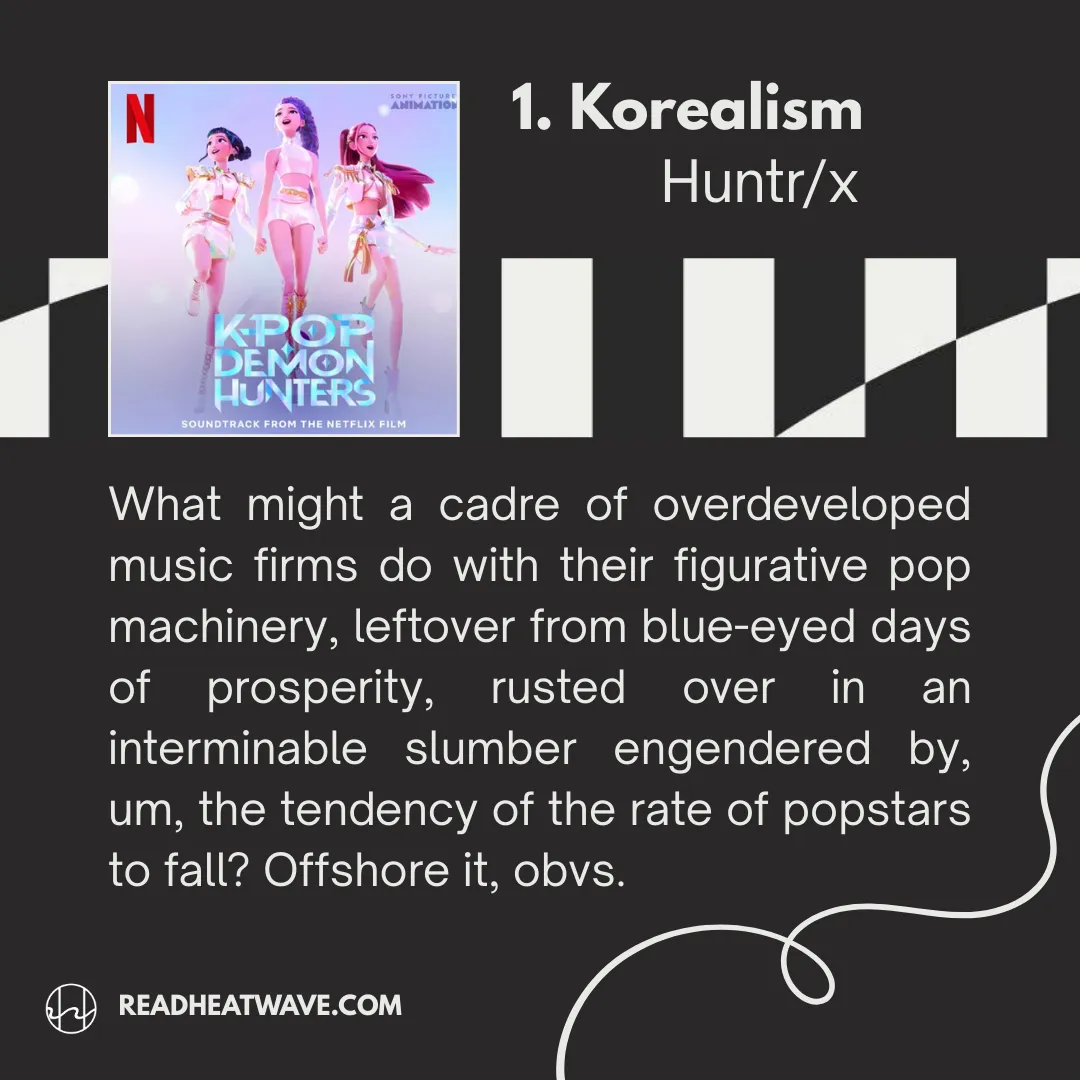
Since the new millennium, the Western music industry has tended away from the models of artistic development that produced the early teenpop stars. The downturns of the 21st century led to a collapse in music biz profits.1 Consequently, American labels reduced their expenditures on artists & repertoire; figures like former Warner Music Group CEO Steve Cooper have gone so far as to announce that they have “reduced [their] dependence on superstars.”2 Combine this with a rapid drop in the price of a song caused by the digitization of music, and you get capitalist logic 101: As rates of return fall, money seeks out new sites of profit. Take this logic one step further, and what might a cadre of overdeveloped music firms do with their figurative pop machinery, leftover from blue-eyed days of prosperity, rusted over in an interminable slumber engendered by, um, the tendency of the rate of popstars to fall? Offshore it, obvs.3 Enter South Korea, which features a highly developed pop ecosystem that rivals the starmaker machinery that existed in the West during pop’s zenith, just before the dot-com bubble burst. And unlike then, access to music today is virtually universal and free, the means of distribution more efficient, markets more expansive. Because the West cannot produce popstars like it once did, the global audience is all for K-pop’s taking. That we cannot just call K-pop what it is—pop—that we insist on the demarcation—this is a residue of the bygone era of American hegemony. We may be variously afflicted with something called Decline Syndrome, but still, in 2025, we all became Korealists.
With K-pop the new colossus, it’s all the more sweet that the songs and story of KPop Demon Hunters amount to an Ars Popetica, a recapitulation of the story of poptimism and its detractors, albeit in inverted form. Our heroes are Huntr/x, a girl-group-slash-demon-hunter trio whose music protects the world from evil. The demons form a rival boy band, the Saja Boys, whose bubbly debut single “Soda Pop” becomes a hit and tips the balance of power toward team demon. “Soda Pop” is the sugar rush, the sweet thing, ephemeral—the debased consumable that stages the critique of pop. It stands against the pop of the Huntr/x, which remains pop, but durable due to its sincerity afforded via the characters’ conscious, personal narrative. The Saja Boys are emptied of personality; they are pure enjoyment, pure pomp, no circumstance. This is, in the movie’s terms, demonic. The movie basically asks, can pop liberate? Are the masses to be trusted? If the world that loves the righteous fight songs of Huntr/x can just as easily be seduced by the empty hooks of high-fructose “Soda Pop,” did pop ever have any liberatory dimension to it in the first place? These questions haunt pop and cannot be answered by the film. However, in this era of global turbulence, in which armed struggle and political assassinations have been put back on the table, we appreciate the film’s bold rallying cry: we are hunters.
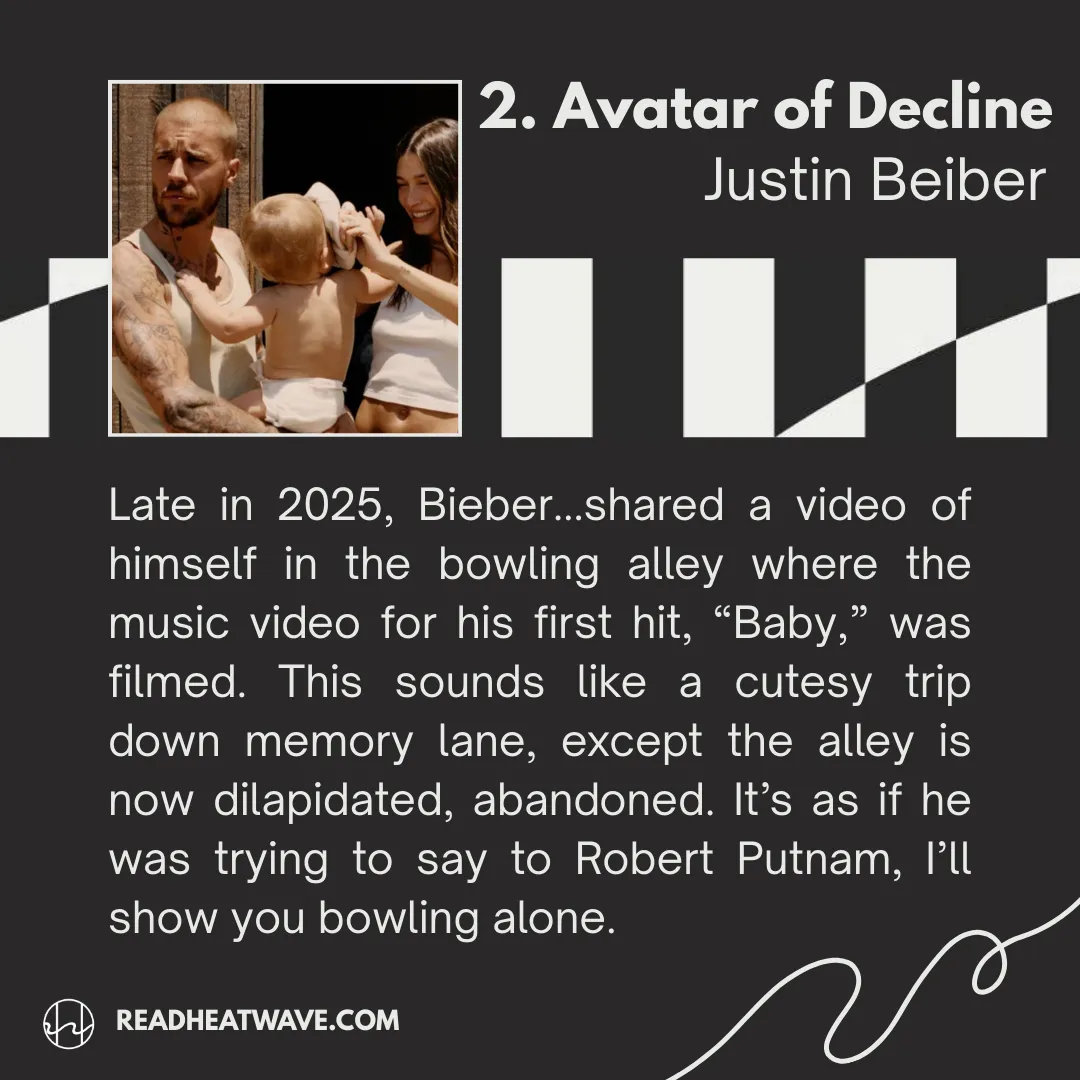
I thought that the celebrity cycle of posting through it, public meltdown, and redemption arc was a thing of the past, but Justin Bieber proved me wrong last year. Not only did he complete the cycle in perhaps record time, he seemed to willfully step into the role of avatar of decline. His supposed personal decline peaked last summer when he gave the paparazzi an avant-spoken word performance, a sermon of scrambled AAVE-gayspeak. It’s not clocking to you that I’m standing on business. Biebs—best experimental poet of 2025.
Then came the music. Gorgeous, sparkly recordings dipped in reverb, the songs scrubbed to abstraction, drained of content and reduced to pure affect, a parade of pop bittersweet nothings signifying only desperation and ache, suspended by a gossamer of vintage coloration and the boy wonder’s tender melisma.
Bieber is probably the last pop star of his kind, groomed by the industry from an early age with the promise of enormity. Again, the money for such ventures has dried up. Late in 2025, Bieber set about illustrating this when he shared a video of himself in the bowling alley where the music video for his first hit, “Baby” was filmed. This sounds like a cutesy trip down memory lane, except the alley is now dilapidated, abandoned. It’s as if he was trying to say to Robert Putnam, I’ll show you bowling alone. He and his entourage sing the song acapella, but it cannot reilluminate this husk of former youth. It’s just fucking bleak. Teenpop is over; innocence, having passed through the millstone of adulthood, traded for diamond dust abjection. Gone, gone.
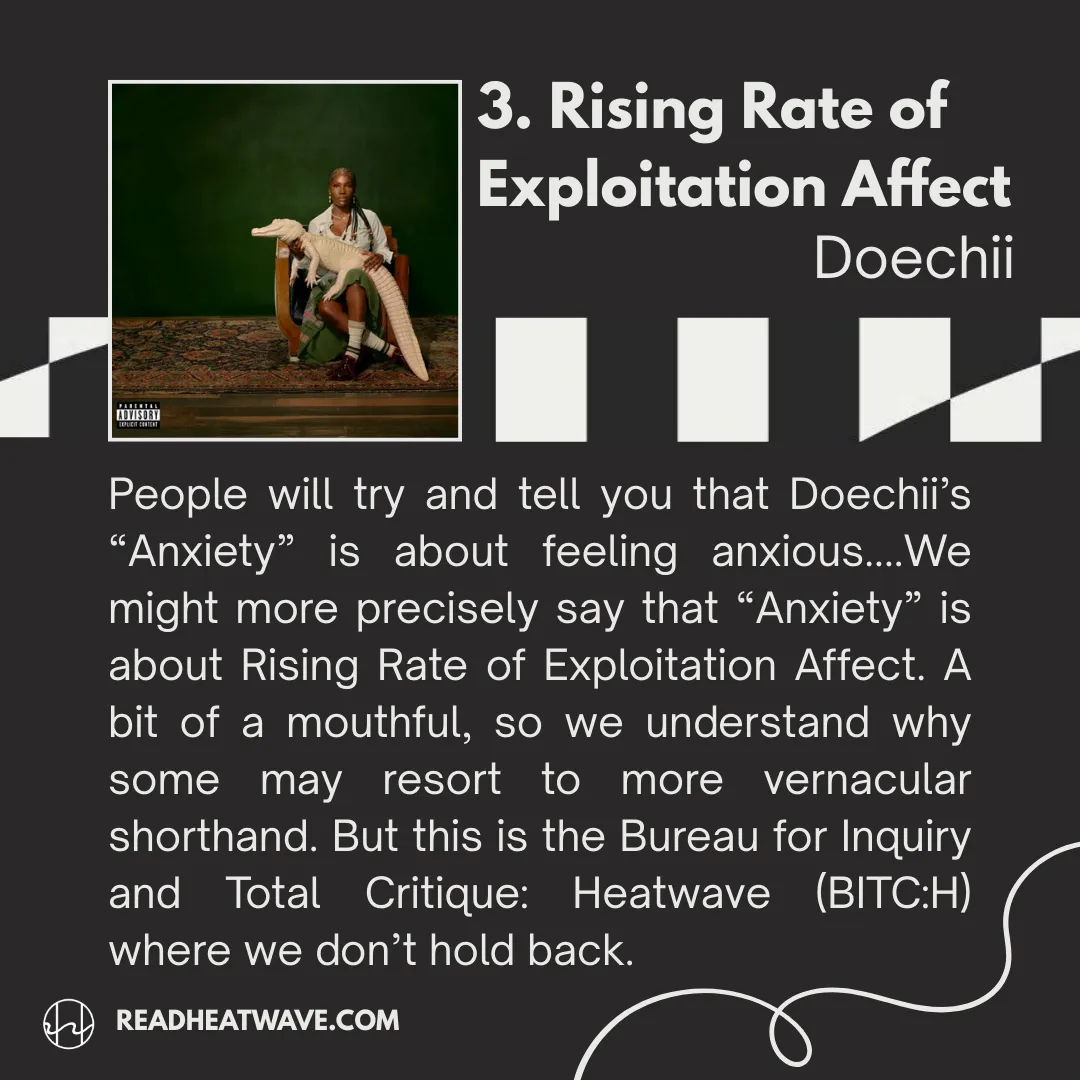
People will try and tell you that Doechii’s “Anxiety” is about feeling anxious. This is lazy, and as true as “Party in the USA” being about Miley Cyrus going to a party somewhere in the territory between Mexico and Canada. We might more precisely say that “Anxiety” is about Rising Rate of Exploitation Affect. A bit of a mouthful, so we understand why some may resort to more vernacular shorthand. But this is the Bureau for Inquiry and Total Critique: Heatwave (BITC:H) where we don’t hold back.
What is Rising Rate of Exploitation Affect? To explain we must take a brief econ detour.
The rate of exploitation—the figure representing labor and capital’s struggle over the share of total wealth—has been on the tongue of every financial analyst this year, albeit in bourgeois terms. Bifurcation, K-shaped growth, consumption concentration. The poor are poorer; the rich, ever richer. Even brand ambassadors for capital are like, this is making us anxious.
And yet the economy is doing…fine. You may have seen headlines this year noting that the top 10% of earners in the US account for nearly 50% of total consumer spending, the highest that share has been in recorded history. It appears that the rich are propping up growth solely through their lavish consumption.
The resulting picture is a dizzying mixture of degradation and stasis. Degradation, because, well, all you have to do is look outside: gutting of the federal sector, slashes to medicaid and food stamps, masked feds terrorizing immigrant communities. Stasis, because the material basis for hegemony is the performance of the economy. You can have all the degradation in the world and no collapse, so long as the line is going up.
In 2012, when “Somebody That I Used to Know” became a global hit, lack was the defining term of the moment. No recovery from the 2008 financial crisis, just millions with jobs they used to have and homes they used to own. Today, what we have is more like a lack of lack. There is no crisis with which to register immiseration. So, when Doechii samples the Gotye song, she makes us recall that we used to know what it was like to used to know someone or something, to feel real lack. This might sound like nostalgia for loss, but that’s not quite right. Lack is the basis for desire. We used to know desire. We would like to feel it again. This lack of lack, this desire for desire—that is the affective dimension of the clunky term we began with.
For all the bleakness of the current conjuncture, it is the ground upon which the song is made possible. It’s fascinating in its usage of free associative rap braggadocio while lacking a typical addressee. There is basically no “you,” just Doechii and her anxiety. Her anxiety. Even if shorn of everything, the feeling belongs to her. But it is less a relation of mutuality than of bondage. Exploitation. In fact, it seems as if the feeling is singing the song, perhaps even the author of the thing. She evokes it, says gotta shake it off of me, and then it takes over, blooming into chorus. Thanks, Rising Rate of Exploitation Affect, for the gift of Doechii. It’s certainly not the least you could do. Things could be way worse.
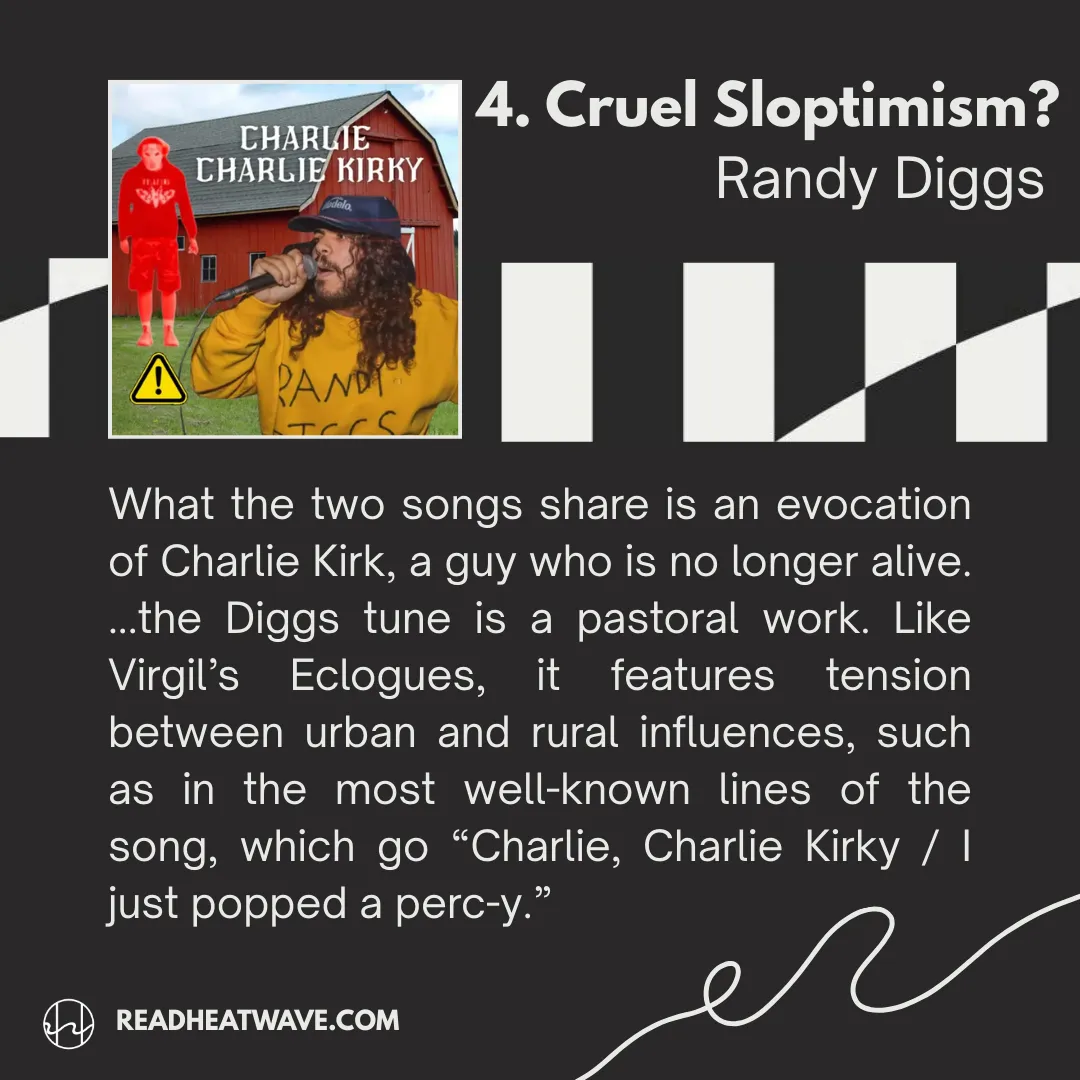
“Charlie’s Barn Yard Song,” by someone named Randy Diggs, is a song. It is a song about a farm. On that farm, there is a barn. The lyrics go “Barn goes, barn goes on the farm.” This astute phenomenological statement acquires additional richness when you learn that the song is in dialogue with “CHARLIE” by Tom MacDonald, a man whose name is metrically appropriate for substitution within the nursery rhyme “Old MacDonald Had a Farm.” MacDonald (Tom) performs what’s known as MAGA rap. He is Canadian. What the two songs share is an evocation of Charlie Kirk, a guy who is no longer alive. The difference is that MacDonald’s is an elegy for the man whose last words were “counting or not counting gang violence,” while the Diggs tune is a pastoral work. Like Virgil’s Eclogues, it features tension between urban and rural influences, such as in the most well-known lines of the song, which go “Charlie, Charlie Kirky / I just popped a perc-y.” Neither song is what one would call “good.” But the Diggs song is antifascist—an experiment in what left-wing culture might look like in the era of AI-slop vulgarity. You could call this cruel sloptimism. Or you could just call it antifascism.
Speaking of antifascism:
The most militant school in the US award goes to UC Davis. This claim is not my own—Charlie Kirk said so on April 3, 2025. I’m just reporting the news.
This nomination came after a group of antifascists confronted a TPUSA event at the university. In widely publicized photo and video, the group can be seen approaching an easy-up tent where the Kirkcels are congregating. At the front of the phalanx are several banners; one reads “TRANSTIFA SAYS HI :3” which is funny. Beth Bourne—a Davis local primarily known for her apoplectic transphobia—approaches the group, upon which someone slips from behind the banners and appears to punch Bourne in the head. This is also funny, and if there is any justice in this world someone will adopt the drag name Bourne Clocky. The highlight though, is when the group reaches the TP tent. The banners part, the group grabs the whole tent, lifting it like a feather, and just walks away with it. Easy up, easy down. As campus police and the fascist chuds watch dumbfounded, “Abracadabra,” Gaga, begins to play from the group’s sound system. Of course! These were magic actions. Poof.
Maya Velli is a writer living in Oakland, CA where she is working on a novel about a plot to bomb data centers by a group of poets who call themselves the Ode to Aphrodynamite.*
Footnotes
-
Niccolo Conte, “MediaCharted: 50 Years of Music Industry Revenues, by Format,” Visual Capitalist, October 20, 2023, https://www.visualcapitalist.com/music-industry-revenues-by-format/ ↩
-
Tim Ingham, “Steve Cooper: Warner Music is becoming less financially dependent on superstar artists — and wants to see ‘regular’ streaming price rises,” Music Business Worldwide, September 15, 2022, https://www.musicbusinessworldwide.com/steve-cooper-warner-has-reduced-our-dependency-on-superstars-calls-for-regular/ ↩
-
Not literally—the figurative “machinery” in this case is formal artistic development. Cooperation between labels, radio stations, and TV broadcast networks gave birth to the teenpop stars of music’s golden era. Prototypically, the nexus of this model was the The Mickey Mouse Club, a show where the nurturing of triple threats—singing/dancing/acting—simply made sense; it was diversification in an artistic investment. As broadcast conglomerates are eclipsed by the streaming giants, this entertainment biz cooperation has diminished. With it goes the accompanying structures for job training, and thus in the final instance shares the effects of offshoring, in which deskilling, disinvestment, and labor arbitrage reshape industry and its locales across global space. ↩