A Summer With A Thousand Junes: Part II
Artifices examines France's most recent waves of riots, particularly those following the police murder of teenager Nahel Merzouk, to theorize race, class, and revolution
Restructuring, surplus population, and riots
“Looting is a natural response to the unnatural and inhuman society of commodity abundance.”
Guy Debord, ‘The Decline and Fall of the Spectacular-Market Economy’.
The process of racialization sketched in Part I does not explain the form that the ‘revolt in the banlieues’ has taken.1 To understand how the contradictory position occupied by the racialized proletariat today finds its expression in looting, we need to consider the ways in which the disintegration of the working class and changes in the reproduction of the capitalist mode of production can constitute rioting as a contemporary ‘mode of regulation’ of social relations. In short, we need to take a look at the phenomenon of surplus populations. The latest restructuring of the capitalist mode of production has, as Endnotes points out, brought back to the fore a fundamental and long-term tendency towards a crisis of reproduction, which Marx called the “general law of capitalist accumulation.” This law states that:
The same causes which develop the expansive power of capital, also develop the labour power at its disposal. The relative mass of the industrial reserve army thus increases with the potential energy of wealth. But the greater this reserve army in proportion to the active labour-army, the greater is the mass of a consolidated surplus population, whose misery is in inverse ratio to the amount of torture it has to undergo in the form of labour.2
In practice, capital must constantly reinvest its profits to ensure that accumulation will continue at a higher rate. This leads to constant innovation on the one hand, and an increase in the rate of exploitation on the other, driving down the cost of production. This maxim of profitability, and the maturation of industries, which occurs when production reaches the market’s relative carrying capacity, causes the rate of profit to fall, and drives some capital to find new sectors offering more satisfactory rates of profit.3 Of the capitals that remain in the low rate of profit sectors, the most competitive are those that manage to maintain a high rate of exploitation while reducing costs, which leads to a relative fall in the demand for labor. Part of the labor force is then expelled from these sectors. Meanwhile, capitals migrate to more profitable territories. However, the productivity gains achieved through technological advances that allow the mechanism of accumulation to run at full speed are spread across the various sectors of production. The new sectors of industry, benefitting from the same types of productivity gains as the old ones, cannot absorb all the labor made redundant by the latter as a result of the increase in productivity. We call this unabsorbed remainder the surplus population. Importantly, surplus population does not refer to absolute overpopulation in relation to an external physical limit; instead, surplus is relative in relation to capital. However, this population tends to become surplus “absolutely […] to the needs of capital,” creating a consolidated surplus population, and this consolidation takes the modality of race.4 The general law of accumulation is thus not simply an account, now widely known (but not always put to good use!), of the contraction/expansion cycles of the famous industrial reserve army according to fluctuations of demand in the different sectors of production.5 It is also a description of how “the dynamic of capital manifests itself as its own limit” in the long run, of a “secular crisis” currently in progress and still to come.6 If we can say that the relative surplus tends to become absolute in relation to “the needs of capital,” it means nothing less than that the reproduction of an ever-increasing number of people becomes contingent to that of capital, that population growth is no longer absorbed by the need for labor.
Against the backdrop of long-term economic decline and crisis, the working class, its identity, its movement, and its means of making demands began to disintegrate. Certain segments of the working class, however, are affected before others by the developments of the capitalist mode of production outlined above. Racialized workers felt the effects of the crisis from the 1970s onwards, being the first to be pushed out of the old sectors and condemned to precarity as a result of the relative decline in demand for labor also affecting the new sectors. Here, the notion of surplus population becomes relevant in identifying an immediate material reality: there is a particular layer of the proletariat made distinct from the rest by virtue of its structural exclusion from the labor market. The 1970s saw the emergence of abjection as a social logic of stigmatization associated with these transformations of capitalism. Abjection names the condition of being “cast off, marked as contingent or lowly, without actually being exteriorized.”7 From police repression to everyday racist state violence, not to mention reactionary media crusades, abjection designates first and foremost the contemporary production and management of the surplus population introduced with the restructuring of the capitalist mode of production.8 The abject is thus nothing other than the proletariat, but “vilified, cast beyond the pale of social respectability.” This specific subject produced by restructuring “is actively taking part in the labor market, but this very activity presupposes that it is expelled from it as soon as it enters it.”9 It then “faces the value production cycle without ever being incorporated into it.” It is thus the symptom of the decomposition of the working class and of the difficulty of achieving its unity, something which cannot be realized either around the old universal subject of the factory worker or around the abject.10 That’s because this exclusion does not define the subject in question, but rather produces it. We need to insist on the fact that racialization, which here is certainly closely linked to abjection, does not simply divide an a priori homogeneous proletarian class but constitutes the class—the position of surplus members of the population has been produced, in this historical sequence, through racial criteria.11 But this position is “at the peak of a process of de-essentialization of labour, a process which now concerns the […] society as a whole,”12 namely the gradual generalization of unemployment and “flexible” work.
As the surplus condition becomes more widespread among the ranks of the proletariat (from the 1980s to the 1990s), the dynamics of abjection seem to become autonomous from their original function of managing and producing a specific surplus population. It seems unsatisfactory to describe this as an autonomization of abjection, an irrational and involuntary result of the desire to manage a surplus population as abjection loses its purely functionalist character, because this process can only be understood by inscribing it at the heart of the dynamics of racism and capital. The abject cannot be taken solely as a neutral category that would apply to particular dynamics (race, gender), and abjection cannot be grasped solely as a model of the general tendencies of these particular dynamics. Abjection is certainly based on fault lines, in this case racial, in the decomposing working class, but race is also the clear and unambiguous expression of it, and it must be accounted for as such. Particular subjects remain the target of these logics, even where and when their economic condition tends to become the norm.
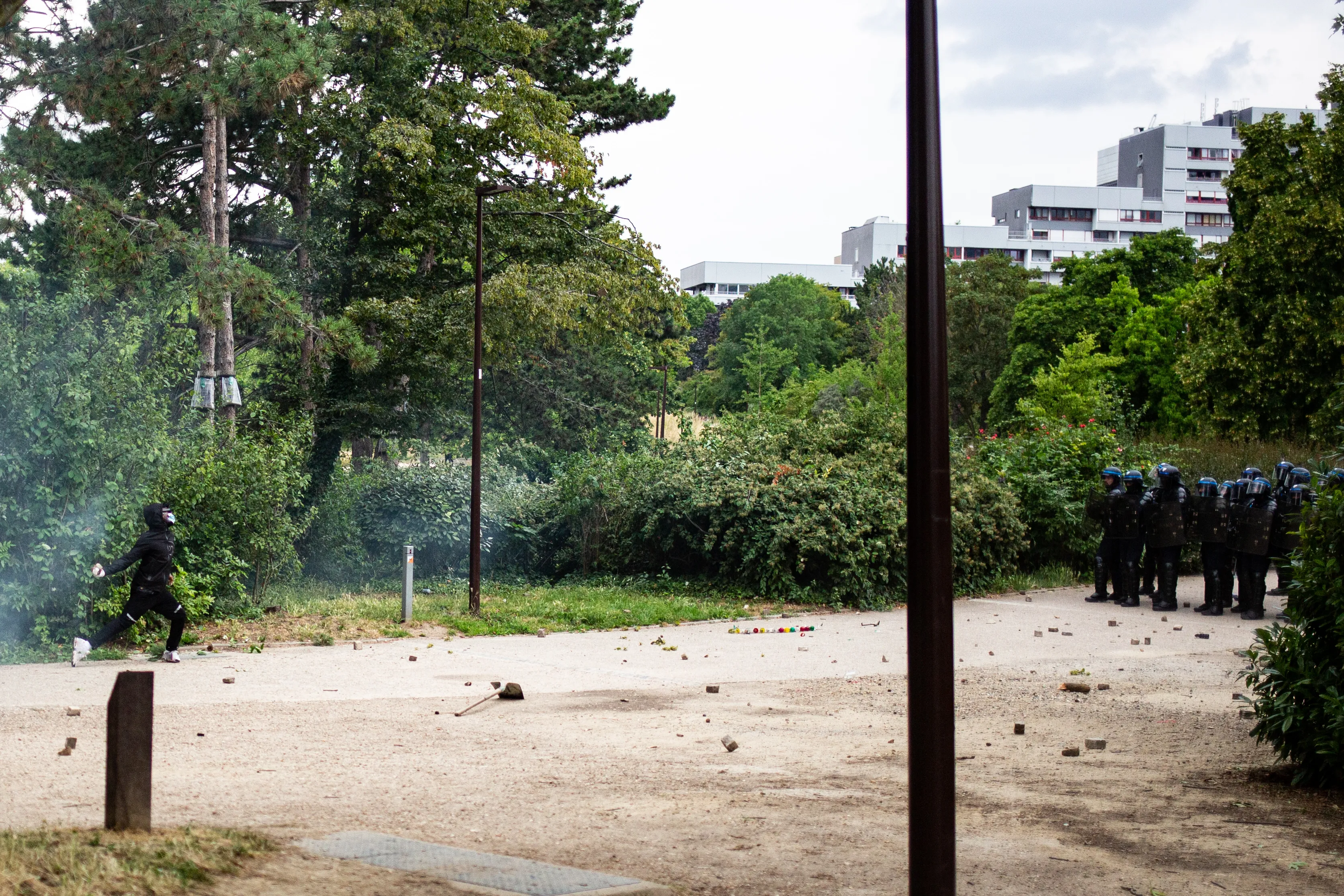
The racialized segments of the working class, excluded from “proletarian respectability” and not integrated into wage labor in any stable manner, have been unable to formulate “regulative demands,” and it is clear that rioting became, from the 1970s onwards, one of the means of expressing and formulating such demands (though the riots could not be reduced to this), which could even win concessions from the state.13 The riot, in its most contemporary form, thus became one of the contemporary “modes of regulation” of class relations, a response to the affluent society. The point here is not to make the surplus population, without further clarification, the contemporary revolutionary subject, the one at the origin of post-restructuring struggles or even revolution, but to show how this category can be relevant to our analysis of the present situation. This category makes it possible to situate this sequence within the long-term trend of decline of the capitalist mode of production, a trend at the origin of the production of a specific racialized subject which happens to be the subject of the riots, and which is also the subject that can be killed, i.e., the target of state violence.14 This subject, surplus in the eyes of capital and the state, is placed under the sole sign of control, and of counter-insurrection once it starts to rise up.15 The absence of political channels forces the state to repress and pushes surplus workers to riot.
The Calm Next Time?
‘Don’t touch the school. The library, the gymnasium, everything that belongs to all of us, that is our common property.’
Jean-Luc Mélenchon, speech on 30 June 2023
Within leftist “anti-racism,” the old problematic was reversed: it was no longer just a question of integrating immigrants into the national proletariat, but of ensuring that the national workers’ movement itself was representative of all fractions of the class. We call this perspective programmatic/programmatist, because of its fundamental belief that unity is possible in the terms of capital, that it can be achieved politically through the positive action of the class to overcome its divisions. Now, without denying the atavistic disinterest of left-wing political forces in the autonomous struggles of immigrants, the structural absence of ways of integrating labor today prevents the class from subsuming racial particularisms. Because they are surplus, the class of wage labor represents for the insurgents an “outside” to their social existence, facing them as an external and, in the end, hostile force. The Left, which had promoted an “egalitarian” integration into the now-defunct national labor community, lost its political function with regard to the surplus population.
In 2005, nobody really talked about the causes of youth anger—or even about the deaths of Zyed Benna and Bouna Traoré.16 There were occasional references to the recent drop in subsidies to neighborhood associations and the abandonment of crime prevention policies, but nothing about the discrimination suffered by young black and Arab people at every stage of their lives (school, work, etc.). As absurd as it may seem, the riots seemed to have come out of nowhere, even though they had been periodically shaking up French housing estates since the early 1980s (car “rodeos” in the Minguettes district of Vénissieux in 1981, riots in 1990 and 1991 again in the Lyon conurbation and the Paris region). Debates about the origins of the clashes focused more on the provocative antics of Sarkozy, the Minister of the Interior at the time. In fact, the “far left” alternated between very critical support and outright condemnation of the rioters, referring to them as an uncontrollable lumpenproletariat or contenting itself with sporadically criticizing the government for not talking about “social issues.”
However, in 2023, the left began to denounce the racist practices of the cops, in particular the “license to kill” granted to them following a law passed in 2017 under the mandate of François Hollande. Since its introduction, the number of shootings at moving vehicles has increased fivefold. The different views on the situation in these urban areas are also linked to the place occupied by the Left within the state. In 2005, the priority for the entire political class, without exception, was a return to order, and support for repression was unanimous. Almost twenty years later, the whole of the institutional left, battered electorally, is dreaming of regaining its place at the negotiating table.17 It timidly followed the riots, knowing full well that it had no control over them, and tried to take advantage of the situation to present itself as a privileged interlocutor between young people with “no bearings” and a state that was in no way interested in talking. So, the left issued condemnation after condemnation of the executive’s repressive stance, often highlighting the racist statements made by members of the government which were allegedly responsible for breaking off the so-called “dialogue.” In a statement with the sober title “Our Country is in Mourning and Anger,” dozens of left-wing trade unions, associations, collectives, and political organizations (La France Insoumise, Europe Ecologie – Les Verts, Parti Communiste, etc.) expressed regret over “the abandonment of these neighborhood populations” and called for “citizen” marches on Saturday 8 July across the country. On the Trotskyist far left, even the most narrow-minded of Lutte Ouvrière [Worker Struggle] teachers have understood that the working class has disintegrated and that the rioters are not an anomaly, but a fraction of the proletariat, which they must support in order to broaden the scope of the Party.
The emphasis shifted from “nothing justifies violence” to “anger must be heard.” The riots stem from a precarious and racialized social context, condemning them serves no purpose, and we should therefore respond to this situation on a social and political level, i.e., embrace the citizenist [citoyenniste] project. The Left in 2023 understands violence, even legitimizes it, but cannot accept that anyone lay a finger on the republican school, the epicenter of its project of social renovation™. The self-proclaimed representatives of the banlieues do not occupy a very different role since their “autonomous/political anti-racism” inexorably concludes with a call to vote for LFI.18 However, there is still a tendency, perhaps a little more marginal, to explain events in terms of rampant delinquency, which distinguishes between good and bad proletarians.
At the end of the day, the slogans and demands of the insurgents have no resonance. Even the LFI deputies labelled as coming from “working-class neighborhoods,” like Carlos Bilongo, were ejected manu militari, and no citizen-activist was able to make the most of the situation and launch a career as a professional peacemaker. The autonomous activists who came as reinforcements had to contend with the mistrust of the rioters.
Artifices is a critical project aimed at bringing the communist hypothesis into existence
Footnotes
-
See Heatwave #1 ↩
-
Karl Marx, Capital: Volume I (Penguin 1982), 798. ↩
-
Endnotes, “Misery and Debt: On the Logic and History of Surplus Populations and Surplus Capital,” Endnotes #2 (2010). ↩
-
Ibid., emphasis added. ↩
-
Marx described the different forms taken by relative surplus population as follows: 1) floating surplus, living between employment and unemployment, with an employment advantage over unemployment; 2) latent overpopulation, ready to be employed by capital as soon as accumulation resumes; 3) stagnant surplus, permanently living in precarious conditions and with very irregular occupation. The limit of the reserve army was designated by Marx under the term “pauperism,” bringing together the population definitively excluded from employment. ↩
-
Endnotes, “Misery and Debt” (2010) ↩
-
Endnotes, “An Identical Abject-Subject?” Endnotes #4 (2015) ↩
-
It should be noted in passing that the methods of management and control, and in particular those of policing, which took place after restructuring had their origins in the colonial system. See, for example, M. Rigouste, La Domination policière, Paris, La Fabrique (2012). ↩
-
Zaschia Bouzarri, “Arson with Demands. On the Swedish Riots,” SIC #3 (2015). https://www.sicjournal.org/arson-with-demands/index.html ↩
-
On the problem of composition, see “The Fate of Composition” in Decompositions, in particular part 2. https://decompositions.noblogs.org/post/2024/04/10/the-problem-of-composition/ ↩
-
Abjection can also be based on other dynamics such as gender. See Endnotes, “The Logic of Gender: On the separation of spheres and the process of abjection,” Endnotes #2 (2010). ↩
-
Bouzarri, “Arson with Demands,” (2015) ↩
-
Didn’t Macron say that the council estate planning [plan banlieue] is a “strategy as old as I am?” ↩
-
“Détruire la république nous semble un objectif raisonnable,” https://604.cafe/Detruire-la-republique-nous-semble-un-objectif-raisonnable ↩
-
The social existence of the surplus population is always virtually criminal, since the framework of legality, i.e*.* the judicial-police management of labor-power, is defined by their exclusion. On a global scale, Palestinian proletarians are the most sadly emblematic incarnations of this category. See William I. Robinson and Hoai-An Nguyen, “Gaza: A Ghastly Window into the Crisis of Global Capitalism,” The Philosophical Salon, January 15, 2024, https://thephilosophicalsalon.com/gaza-a-ghastly-window-into-the-crisis-of-global-capitalism/ ↩
-
The riots began in Clichy-sous-Bois and Montfermeil on 27 October, following the deaths of Zyed Benna and Bouna Traoré, two teenagers who were electrocuted inside an electricity substation while trying to escape a police checkpoint. Three days later, a tear-gas grenade was thrown at the entrance to the Bilal mosque. This police provocation spread the riots in Clichy-sous-Bois to the whole of Seine-Saint-Denis, then two days later to many other communes. The government declared a state of emergency on 8 November and extended it for three months, even though the clashes had already ended by 17 November. ↩
-
The anti-racist struggles of the last fifteen years, from the Truth and Justice committees [Comités Vérité & Justice] to the international stir caused by the BLM movement, have of course played a considerable role in this political shift, but an analysis of these movements is beyond the scope of this article. ↩
-
On La France Insoumise, see Gilles Dauvé, “Tales from the (French) Far Left,” in this issue. ↩