Fire To The Prisons: Issue 2
On September 9, 2025, Fulton County Judge Kevin Farmer dismissed racketeering charges against all 61 defendants accused of conspiracy in relation to the movement to Stop Cop City. Believed by legal experts to be the largest criminal racketeering case filed against protesters in U.S. history, the trials of the Stop Cop City 61 appear to have been suspended, for the moment at least. What does this all mean?
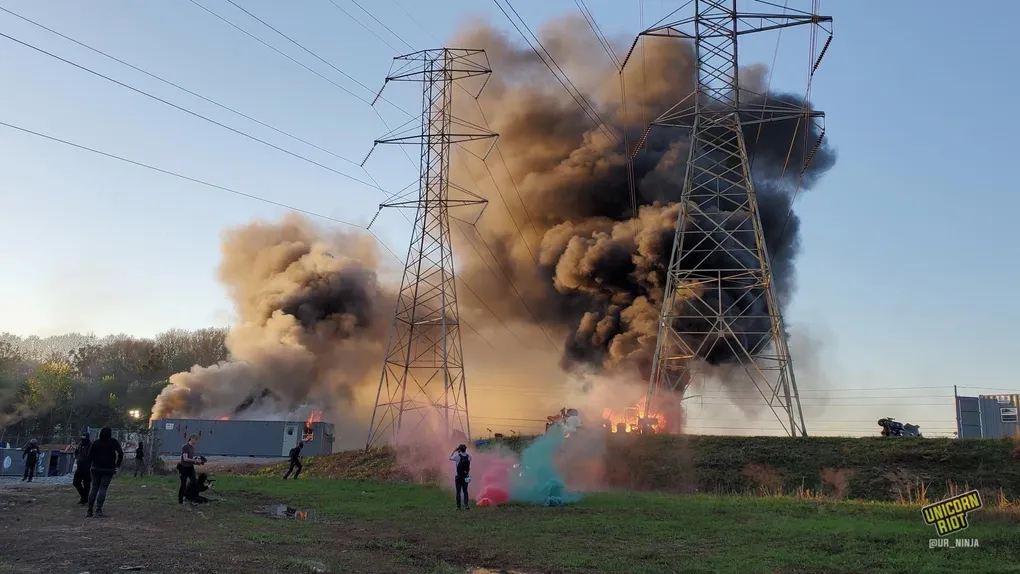
Fire to the Prisons
Fire to the Prisons is a regular section of the magazine dedicated to prisoner struggles and support efforts. The name “Fire to the Prisons” is a nod to the popular anarchist magazine of the same name in circulation since 2007. While our project centers some struggles over others, we make no distinction between political prisoners and regular prisoners. For us, all prisoners are class war prisoners. In this installment, we hear from two different struggles that, while localized, are far from parochial. Fire Ant Movement Defense write about their efforts to support the Cop City 61 and the movement to Defend the Atlanta Forest. Care Not Cages offer a report about their efforts to stop jail expansion in Indiana. Indeed, each reflect the ways that repression and incarceration function at a systemic scale, as economic and fiscal crises increasingly force the state to intervene with violence to maintain a semblance of order as generalized social disintegration proceeds.
No New Jails
First, they filled the prisons. You know this part of the story. The US dumped the social problems it refused to address into the brutal system of mass incarceration now infamous for ruining whole communities, especially of Black and working people. But do you know about how they filled the jails?
Jails are smaller, local institutions that are supposed to cage people not yet convicted. As prison populations in the US exploded in the 1980s thanks to decades of sentencing “reform,” prison building sprees, and the notorious War on Drugs, jails increasingly held people convicted with short sentences. They became horribly crowded places, too jammed to offer treatment, counseling, or services people needed while inside. They became frequently more violent and depressing than prisons themselves.
As critiques of mass incarceration mounted, politicians looked for easy outs. One law, pioneered in California in 2011 and then embraced elsewhere, involved redefining crimes so that shorter sentences for more minor offenses could be served in jails instead of prisons. California’s jail population increased by 11,000 people in the two years directly following this sentencing “realignment.”1 Jails were already bad by then. Boy, did they get worse.
In our red, midwestern state of Indiana, lawmakers passed sentencing redefinition legislation in 2014 that flooded our jails. In just three years following the new legislation, the prison population fell from 30,000 down to 23,000 while the jail population climbed from 15,000 to 18,500. Then the prison population rose again to 27,000 while the jail numbers stayed about the same.2 Of the ninety counties in the state that have jails, over a third have built new ones since then, and many more are in the planning stages. This is our situation in Bloomington, the seat of Monroe County in south central Indiana. Small town life.
The attempt to decrease prison populations through sentencing redefinition just ended up shifting the burden to local jails, where populations skyrocketed. The carceral system as a whole didn’t get any smaller. And local governments had to foot the bill by taxing their residents and issuing municipal debt. Fuck the state-level politicians, their shallow promises to shrink incarceration, and their ultimate net-widening results.
Lots of counties building lots of jails. Lots of activists opposing them. Fighting jail expansions has been a front for abolitionist activity for two decades now, networked through national-level grassroots orgs such as Critical Resistance. Organizers argue for funding the treatment and prevention services that can keep people out of jail in the first place: housing, physical and mental health care, addiction services, transportation. Shrink the pipeline, duh.
One such group is our crew, a buncha activists practicing prison abolition on a local level under the banner of “Care Not Cages.” Our county proposed a new jail fifteen years ago, but we beat it. They began again in 2021, trying to buy a piece of property for a site even though they already owned a site they had purchased in 2002 for just that purpose. Eventually they spent $11 million to buy a whole different site—before any plans were approved or the bond issued. Their current plan costs over $330 million dollars, including interest, and that’s without new sewers, electricity, and transportation (there are inadequate roads to this new site, and no bus service). They lie to avoid the obvious conclusion: the county should renovate the existing jail and channel all available resources to prevention and treatment, the kinds of things that actually make our community safer.
For four years now, we’ve been tracking the fiscal cupidity of local elected officials, fighting their hypocrisy and exposing their lies. It’s a long list, including:
-
Refusing to implement recommendations by their own hired consultants and professors from the state university to combat recidivism, keeping the population high.
-
Suspending a committee they had convened to determine how to divert people from entering jail and help people leaving with what they needed for re-entry. That committee voiced a lot of opposition to new jail construction, so it had to go!
-
Wasting money on building a parking garage next to the jail instead of upkeep.
-
Refusing to provide adequate mental healthcare in the community; preferring to jail people with mental health and substance abuse issues, making the jail the largest mental health care provider in the community.
-
Wasting money flying the county commissioners and staff to Arizona and Ohio to visit new jails that might serve as models for their expansionist ambitions.
-
Choosing the contracting company behind closed doors without sharing selection criteria with the public. Sweetheart deal, anyone? Care Not Cages actually won a judgment against the county for violating the state’s “Open Door” law for public meetings, though they didn’t suffer any consequences.
-
Claiming the old jail couldn’t be renovated because it was multi-story, then coming up with blueprints for a new jail that is multi-story.
-
Claiming the old jail didn’t have sufficient outdoor space to treat people humanely and then designing a new jail in which people would never go outside.
-
Commissioning the study, required by law, to determine whether it was cost-feasible to renovate the existing jail, and then when they didn’t like its conclusions, sending the consultant back to the drawing board with specific instructions to make renovation sound more expensive.
-
Insisting repeatedly to the public that renovation was impossible, despite the findings of the revised feasibility study that renovation could be accomplished for less than $80 million.
-
Raising local income taxes twice to generate nearly $18 million per year for bond (debt) repayment.
-
Moving funds away from services for at-risk youth to earmark for the new jail.
Care Not Cages works doggedly. We make our points. We go to county meetings and try to present our arguments. We write emails and compose newsletters. We go to the farmers’ market and art fairs and protests and hand out flyers. We use humor. Once we put on a series of skits timed precisely to the three-minute period people are allowed for public comment. That was fun. You can see some of our skits in videos on our website. We network with local orgs run by people with lived experience of incarceration and the issues that make people vulnerable to it. Nobody wants to leave the system as it is. The existing jail is horrible.
Recently, the state gave us a beautiful gift inside a horrendous piece of legislation. It was a huge budget bill with all kinds of cruel cuts to services people in the state desperately need. But it had one interesting provision: it set a limit on how much debt counties can take on based on the total assessed value of their properties. Our county wanted a debt service about double that. So now they can’t borrow enough money to build a new jail. The county does have enough money to renovate the existing one, though—and provide the treatment and prevention services people really need.
Remember how back in 1994 the Zapatistas had the last laugh? In Monroe County, Indiana, we say it again: First World, Ha Ha Ha!
Read more about Care Not Cages here.
Movement Defense and the Trials of the Stop Cop City 61
What Happened, What’s at Stake, and What’s Next
On September 9, 2025, Fulton County Judge Kevin Farmer dismissed racketeering charges against all 61 defendants accused of conspiracy in relation to the movement to Stop Cop City. Believed by legal experts to be the largest criminal racketeering case filed against protesters in U.S. history, the trials of the Stop Cop City 61 appear to have been suspended, for the moment at least. What does this all mean?
In the immediate, little is clear and caution seems warranted. Judge Farmer claimed that Republican Attorney General Chris Carr did not have the authority to secure indictments under Georgia’s Racketeer Influenced and Corrupt Organizations (RICO) law. The case is not limited to racketeering charges, however. Under the indictment, five of the 61 defendants were also charged with domestic terrorism and arson in relation to an uprising that swept downtown Atlanta after the murder of Tortuguita in early 2023. Judge Farmer has dropped the arson and RICO charges, but as of this writing, it is uncertain whether he will dismiss the entire indictment or allow the domestic terrorism charges to stand. Either way, the AG will surely appeal. There are no easy victories before us.
For the state, the Stop Cop City trials are not about the guilt or innocence of the defendants. They’re about the state’s persistent nightmares of the George Floyd Uprising. It doesn’t matter to Chris Carr, who wants to be elected governor in 2026, that the youngest defendant, Ayla King, was sixteen years old and living in Massachusetts when the Minneapolis third precinct burned. His goal in accusing Ayla and sixty strangers of engaging in a criminal conspiracy which he alleges began the day George Floyd was murdered is quite simple: to assert at will authority to suspend the freedoms of assembly and association. He seeks to establish a precedent that any person who attends a protest can be held legally responsible not just for any crimes committed that day, but for any crimes committed under similar banners or slogans years before or after.
This is not a new strategy. Prosecutors have been trying (and mostly failing) for years to do the same thing. The vast majority of the more-than-nine-hundred protesters arrested in Atlanta during the summer of 2020 were simply grabbed out of crowds and charged as if they were personally responsible for the actions of the whole crowd. These exaggerated charges allowed the state to extract plea deals and enact a certain amount of pre-trial punishment, but they largely failed to stick. Five years into the reactionary period following the 2020 uprising, within and against which the Stop Cop City movement emerged, Georgia went a step further in trying to use its RICO statute to redefine the de facto rules governing protest, a move that would surely cause ripples across the US.
To understand how we should respond to this situation, it’s important for us to make a detailed analysis of the repressive tools in use. On one hand, the state’s original case was weak. The entire RICO prosecution was a house of cards, built on preexisting bogus charges against people who were grabbed randomly at public protests, people who were in handcuffs in the back of cop cars when the crimes they are accused of occurred, people who had the misfortune of being in a public park when the police decided to do one of their multi-agency militarized raids, people who ran a by-the-books nonprofit. It might not be obvious to distant observers, so let us be very clear: the RICO charges against Stop Cop City protestors were not the result of some deep investigation into the inner workings of the movement. Prosecutors simply went through their files of previous arrests, picked sixty-one people, and worked backwards to invent a conspiracy to lump everyone into.
We can view the sloppiness of this RICO case as the result of the movement’s offensive capabilities and successes. Prosecutors were under extreme pressure from Georgia’s governor, Atlanta’s mayor, and the backers of Cop City to do something—anything—to stop the attacks on the project. The result is a stretch, even by the standards of the Georgia RICO statute itself. It’s hard to come up with similar examples without sounding absurd. It’s as if everyone who was arrested at the Philly sports riot after the Eagles won the Superbowl were charged with RICO. It’s as if everyone who got speeding tickets on the interstate were accused of forming a criminal conspiracy to drive too fast.
Therein lies the problem. Ask yourself, are comically overblown charges less threatening because they’re less likely to stick, or are they more threatening because the potential consequences are so dire?
This is exactly why the state finds it so useful to levy these charges. No matter how strong a defendant’s case, the threat of the worst-case scenario is enough to disrupt every aspect of their lives and force defendants and the movement to redirect labor and funds toward legal defense.
It has become something of a truism that the way movements escape this trap is by growing in response to repression. Yes, but how? What kind of growth? In what direction? And how do we nurture it? We can all think of times when it just happened; when a particularly vile act of repression shocked large numbers of people out of complacency and into action: the dog attacks at Standing Rock that brought ten thousand people out the following weekend or the federal snatch-squads in Portland in 2020 that brought an influx of middle-aged moms and dads onto the streets. But we can’t rely on this dynamic alone, especially in this catastrophic era of accelerating, compounding atrocities. So how else can we grow? Can we grow qualitatively in response to repression, becoming more organized, more dedicated? Beyond spectacular moments of shock and outrage, how can we politicize repression to build class power?
The various answers to these questions are the basis of a movement defense strategy. Political repression may target individuals, but it’s aimed at the movement and must be addressed at that level. This doesn’t mean abandoning the aspects of anti-repression that operate at the individual level and are necessary to keep people out of jail in the short term, but such efforts are just some of the building blocks in a broader movement defense strategy. In the long term, it’s only by continually building the strength and offensive capabilities of our movements that we will be able to defend against repression.
We formed Fire Ant Movement Defense as an organization dedicated to continually asking the questions above and developing our collective capacities for answering them. We are starting with a focus on Stop Cop City, setting ourselves the task of identifying what’s lacking from a robust defense of the movement and filling those gaps. This will entail a process of growth in which we develop the capacity to do the many varied things that need to be done, from mass-cooking for weeks of court-support rallies to researching and publishing detailed analysis of the inner (or outer) workings of the repressive apparatus. Our aim is to be expansive, to grow the organization and the movement to meet the task before us, and to carry those gains forward into other struggles.
We invite all opponents of Cop City to join us in this effort. There are many remaining charges from the movement to Stop Cop City (though many of these have not been indicted and may not move forward). Notably, Jack Mazurek has been indicted on arson charges in Fulton county, which carry a maximum sentencing of 20 years in prison. And in South Carolina, ‘Nile’ Spigner is awaiting trial on arson charges. She was 23 at the time of her arrest for allegedly destroying equipment owned by a Cop City contractor. Please support the accused. This can mean traveling to help ensure that defendants walk into court each morning to cheers from a crowd of supporters. It can mean watching the livestream video of court proceedings and editing clips for social media or ordering pizza to support rallies outside of court. It can mean donating to defendants or movement defense efforts. It can mean researching the Georgia Attorney General who is prosecuting these cases or the broader Fulton County system of injustice and mass incarceration. It can mean helping design flyers or holding a local action or fundraiser to support defendants and fund supporters traveling to Atlanta.
Follow Fire Ant Movement Defense for event announcements and updates and get in touch at fireantmovementdefense@proton.me.
Get updates on Jack’s case at freejack.co
Footnotes
-
Todd D. Minton, “Census of Jails: Population Changes, 1999–2013,” U.S. Department of Justice, Office of Justice Programs, Bureau of Justice Statistics, December 2015, NCJ 248627; online at https://bjs.ojp.gov/content/pub/pdf/cjpc9913.pdf (Accessed 8/10/25). ↩
-
Prison Policy Initiative, “New data and visualizations spotlight states’ reliance on excessive jailing,” April 2024, “Indiana’s Prison and Jail Populations,” online at https://www.prisonpolicy.org/graphs/jails2024/IN_prison_jail_populations_1978-2022.html (Accessed 8/11/25). ↩