A SUMMER WITH A THOUSAND JUNES: The Nahel Riots and the Communist Hypothesis
In part 1 of "A Summer With A Thousand Junes," Artifices examines France's most recent waves of riots, particularly those following the police murder of teenager Nahel Merzouk, to theorize race, class, and revolution.
By Artifices
translated from French by Enzo Bodine & otto dix rivers
Part I
This text was originally the second part of a project to analyze the intense episode of class struggle that shook France in 2023. The first text was devoted to the social movement against the pension reform bill, which lasted from January to June 2023. The aim was to show how the movement was not defeated but came up against its own limits. In particular, the “riotous moment” of this period, during which numerous wild demonstrations took place in reaction to the government’s “passage en force”, was not taken for what it really was. By focusing on the “riotous” form of these demonstrations, which went beyond the trade union framework, it was little noticed that their content - the questioning of the State by its citizens and the internal criticism of democracy - was identical to that of the trade union side of the movement. But we came away from 2023 noting that, to each of these [inter-classist?] “errands,” the proletariat “responded with insolent lines of flight.” The Gilets Jaunes movement in 2018 was a case in point. The riots that followed the murder of Nahel Merzouk in Nanterre by a policeman were another, and are the subject of the second article, which is translated below. A few weeks after the end of the pension movement, and in the space of a few days, these riots raised the question of communism far more than the long months of social unrest that had already ended in certain defeat.
This second text on the June riots is also part of the history of suburban riots following racist police killings. In particular, the riots of 2005, following the deaths of Zyed Benna and Bouna Traoré, two teenagers who died while being chased by the police, gave rise to a number of analyses within the far left and the left, most of which condemned the use of riot and the rioters. It is therefore on the basis of the reflections of the communization milieu in 2005, which disagreed with these condemnations, that we have written this text. First, we recall the general state of class struggles after restructuring, and how the particular situation of the racialized proletariat reveals the general state of social relations. Secondly, we look at the Left’s reaction to the riots. We note that the Left’s discourse shifted from a strong condemnation of the riots to a civic minded “il faut comprendre” (“we must understand”), which found little favor with the insurgents. Finally, we look at the riot itself, concluding (contrary to certain analyses of the autonomous milieu) that while this episode did not represent a process of insurrection, it did represent an outline of one. Echoing our first text on the pension movement, we criticize conceptions of the “riot” as an essentially revolutionary overcoming of the present situation.
We had explicitly chosen to write two texts on 2023: the first in response to the many analyses that seemed to us to miss the point of the pensions movement, the second in response to the few analyses that seemed to misunderstand the nature of the June riots. The reactions we received confirmed this imbalance of interest in the analysis between the social movement and the Nahel riots. Yet we still believe that the riots were a far more intense episode of class struggle than the long months that preceded them. The whole of 2023 also, and above all, seemed to indicate the twilight of the cycle of struggles begun since the last restructuring, rather than the umpteenth repetition of a citizens’ social movement. So we remain ever vigilant to class struggles as they unfold, in order to grasp their rapid mutations in this period of crisis of the capitalist mode of production.
The end of spring
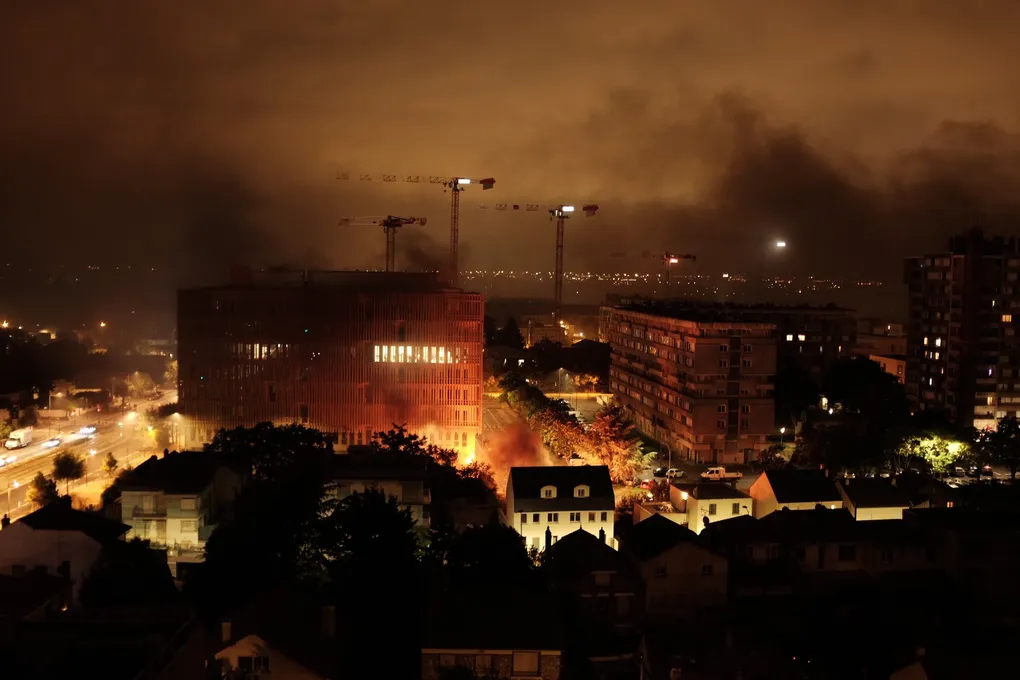
On 27 June 2023, a video of a police killing during a traffic stop made waves on social networks. It showed two cops shooting the driver of a stationary car in Nanterre. While the event itself was unfortunately nothing out of the ordinary for the racialized proletariat of the French “banlieues,” the existence of a video showing the open barbarism of the murder of a 17-year-old teenager for all to see gave specificity to what could have remained just a local news item—like a recent murder of the same kind in Cherbourg. The wide circulation of the video quickly provoked an explosion of anger, leading to—among other things—a wave of riots on the evening of the crime.
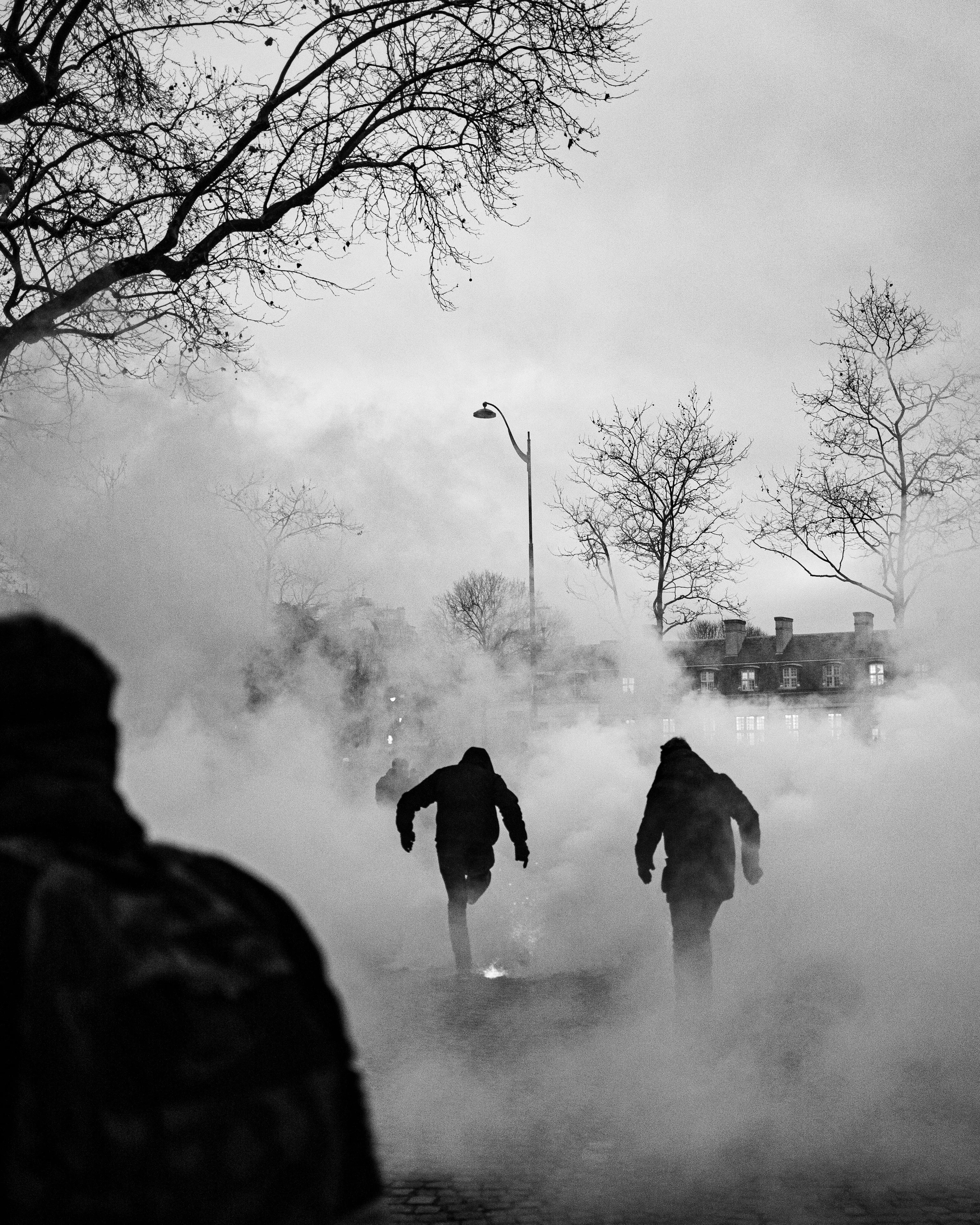
While the eruption of riots in response to a police murder is not in itself exceptional,1 the riots that followed Nahel’s death had a singular impact on the year 2023—if not beyond. Their intensity, dynamics, and content, as well as the subsequent crackdown, marked a particular moment in the more general class struggle. As soon as the first clashes began, the event definitively silenced the last psalmodies of the movement against pension reform2 and announced a level of political offensiveness unseen in France since the most glorious acts of the Gilets Jaunes. As a result, the riots enjoyed widespread support, including in the ranks of the far left, whereas similar events had been unanimously condemned after the deaths of Zyed and Bouna in 2005.3 Paradoxically, the response to the riots in our circles can be summed up as inaudible expressions of solidarity—in the form of exalted slogans—with the rioters. Although they only lasted a handful of days, we believe that these riots were an important moment in the current cycle of struggle, the story and legacy of which must be kept alive.
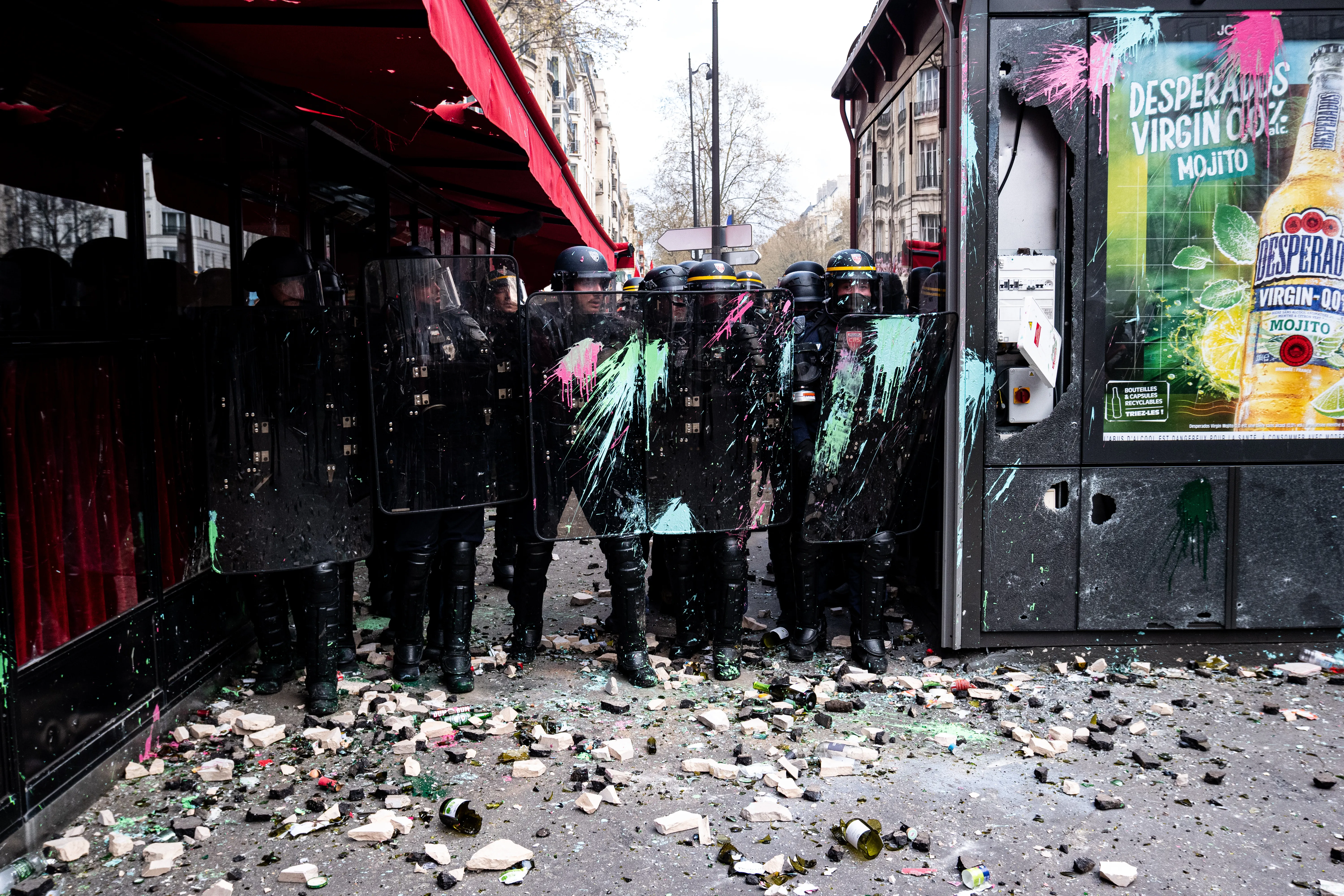
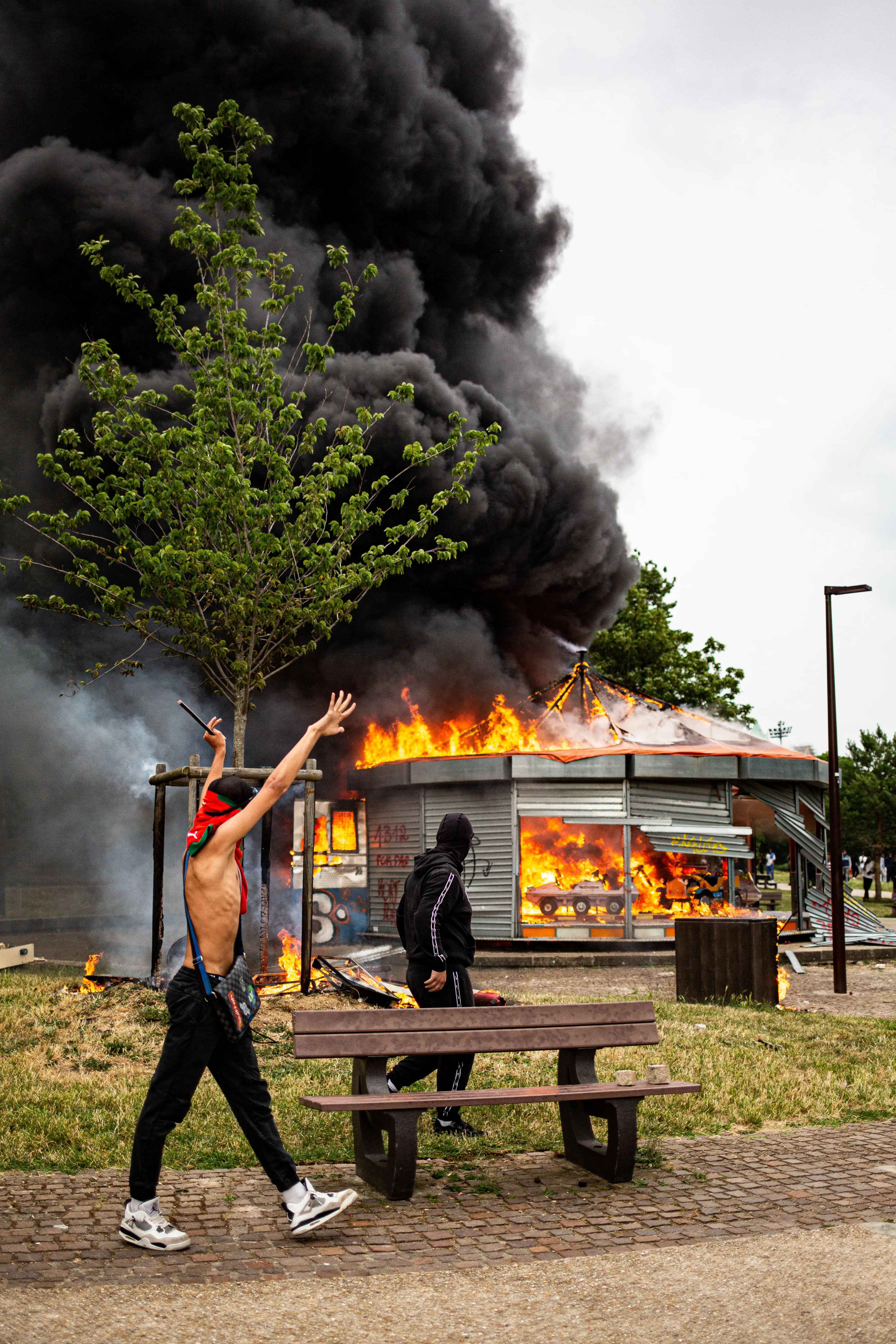
On June 27th, riots broke out, although at the time they were confined to certain districts of Nanterre, and a few fires spread, mainly in the 92 [French département close to Paris], a few districts in the Paris region and a handful of other large towns. The following day, the riots spread to many cities across the country. On June 29th, a white march took place in Nanterre, bringing together Socialist Party (PS) MPs and autonomous activists in the middle of inhabitants from the surrounding banlieues. A not-so-anecdotal fact: Nahel’s mother refused to call for calm. Attacks on prisons, public transport, CAF offices [Social Welfare offices], schools, libraries, nurseries, police stations, tobacco shops and supermarkets became the norm in the days that followed, even in residential areas deemed to be “quiet.” Journalists were beaten up and their equipment stolen before the contents of their film ended up in the offices of the judicial police.
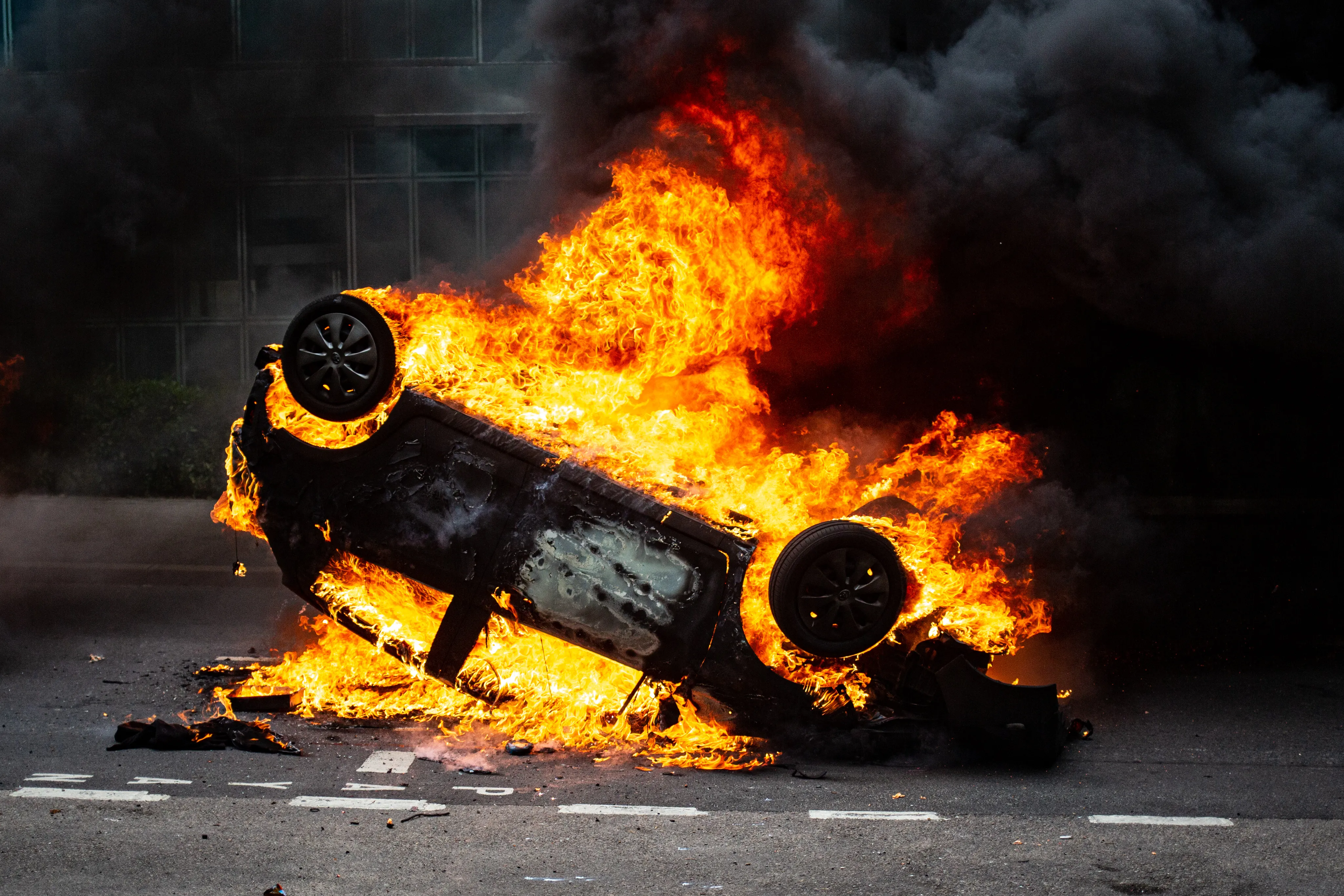
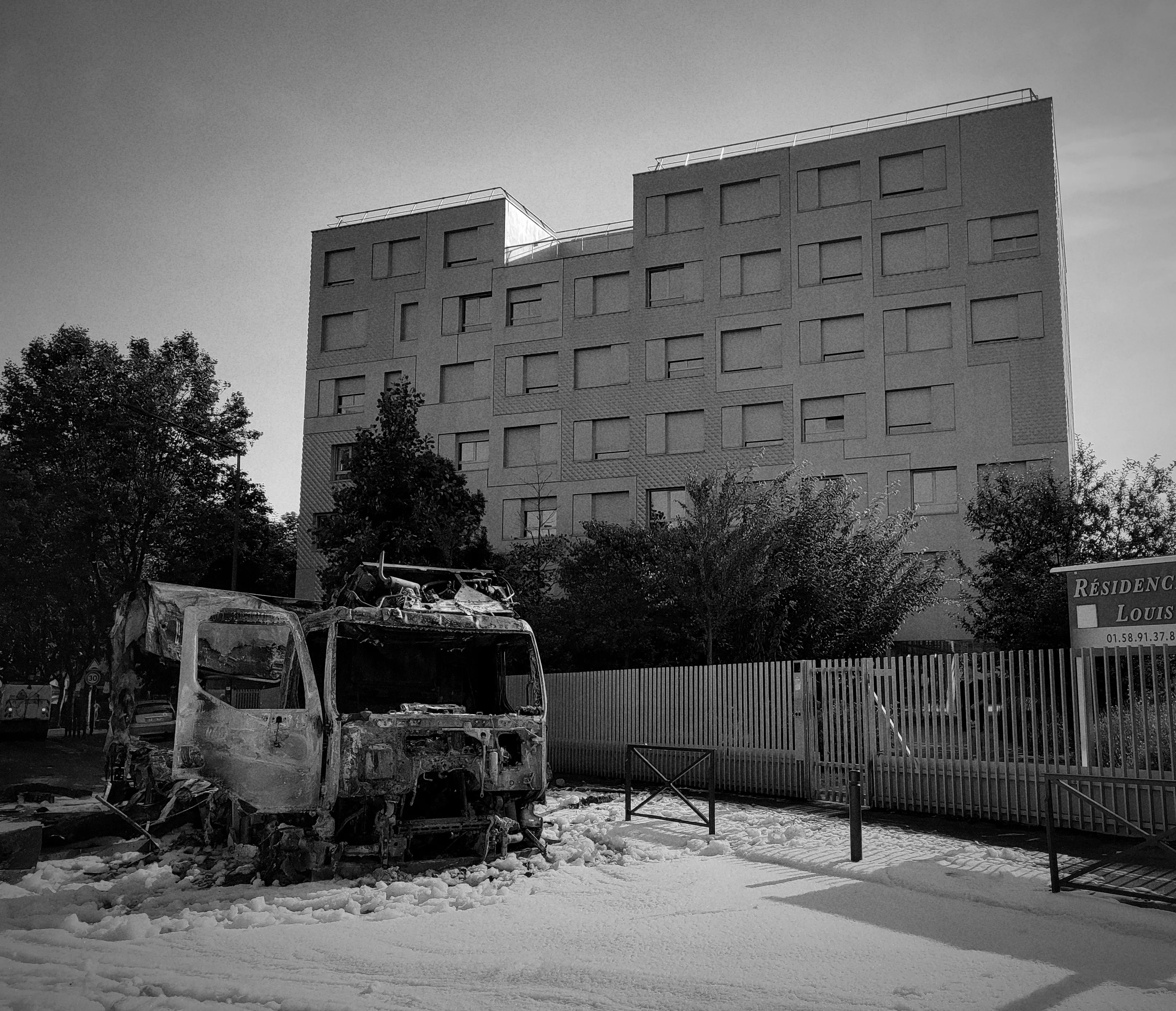
The Senate did the math: 2,500 buildings hit, 12,000 cars burnt and 782 cops injured in 672 communes and 95 of the 101 départements. In just one week, these figures exceeded those of 2005, which had lasted three weeks, and the riots spread at an unprecedented rate, particularly in medium-sized towns.
The government decided to deploy elite troops (RAID, BRI, GIGN) to supplement the 40,000 cops and gendarmes sent to quell the riots. The Prefect of French Guyana announced that a local civil servant had died from a stray bullet allegedly4 fired by rioters. On the 30th, the riots continued to spread and intensify, town halls were burnt down and a freight train was attacked. The next day, in Marseille, the city center was out of control for several hours and RAID police officers shot Mohamed Bendriss in the chest with an LBD (“defense bullet launcher”). His cousin had been shot in the eye by the same ‘non-lethal’ weapon the day before.5 The riots continued over the following days, gradually losing momentum until 5 July, when the violence dropped sufficiently for the media to jump on the occasion and declare the sequence over. Although a few clashes persisted, the riots had lasted only 9 days, with the return of order proving to be as swift as the outbreak of the revolt. Nearly 4,000 people were arrested, and a third of them received prison sentences, three times as many as in 2005. The material damage caused by the riots reached an unprecedented level, with insurers putting the figure at over a billion euros.
A few weeks after the movement against pension reform, the riots opened up a breach in the daily course of the class struggle that the earlier demonstrations had not even been able to glimpse. But while comparison makes the qualitative differences between the two movements obvious—and the limitations of the first blatantly apparent—there remain few analyses of those summer nights, whose intensity could only be contained by the brutality of the repression. Traces of melted asphalt under the burning cars were the only scars of an episode too quickly consigned to history. Without fantasizing about a movement that did not give birth to communism, we feel it is vital to reopen the debate about these riots. We intend to see them for what they are, neither purely racial nor purely proletarian: riots by racialized proletarians—racialized in so far as they are proletarians and proletarians in so far as they are racialized.
The misadventures of class struggle
“To be a poor man is hard, but to be a poor race in a land of dollars is the very bottom of hardships.”
W.E.B. Du Bois, The Souls of Black Folk
Leftists in search of a revolutionary subject, sociologists and/or cops—all observers of the blaze that swept through the French suburbs in the summer of 2023 asked the same question: who were the rioters? I.e., what was their employment status, their sociability, what were their grudges, and, ultimately their goals? In short, to gain a foothold it was necessary to translate their activity, as best as possible, into the language of politics. But attempts at filling such a gap in the matter at hand with statistical research are not without their pitfalls and there is the risk of losing the point entirely.
There was, of course, the crime itself, the militarized crackdown, and the odious pot of money the far-right fundraised for the murderer to thank him for having so zealously served the endocolonial order. All this belongs to the realm of injustice and is easily accessible to any documentary examination. But there was also the uprising, which never directly answers to its trigger but rather pursues its own history, mapping out possible paths to its own overcoming.
When Debord wrote, in a similar context,6 that it is the task of revolutionary theory to provide the rioters with their reasons, he correctly recognized that the task of communism can only be raised from the point of view of the riot. The situationists embraced this perspective when they argued that it was because of “augmented survival”—the advertised proliferation of commodities meant to satisfy the artificial needs of “alienated” individuals within the spectacle—that white people failed to grasp what the black proletariat was already contesting in practice. As passive consumers of commodities, whites would be subjected to this “drug” of the spectacle and submit to its dictates. In contrast, Black people, for whom access to wage labor is tenuous and whose material misery precludes any superfluous consumption, would prove unassimilable by a spectacle that has nothing to offer them.
The logic of the spectacle exhibits an immanent contradiction here. On the one hand, advertising and the reign of the commodity universally impose property and consumption as the insatiable fulfillment of social life. On the other hand, access to these commodities is restricted to the minority of workers earning substantial wages. It is this gap between the material reality of the black proletariat and the promises of the spectacle that makes them conscious of their social misery: “The blacks of Los Angeles are better paid than anywhere else in the United States, but they are even more separated than elsewhere from the maximum wealth that spreads out precisely in California.”7 But the situationists thought this rift could only become concrete if Black people were confronted with an ostensible abundance of commodities, otherwise absolute poverty would prevail over the spectacle’s contradictions, condemning proletarians to inactivity and despair. Excluded from the process of capitalist circulation, where exchange value rules over social relations, Black people had no choice but to destroy, through looting, the value virtually contained in commodities and usually realized in the act of purchase, allowing only concrete use values to survive.
“Like the young delinquents of all the advanced countries, but more radically because they are part of a class without a future, a sector of the proletariat unable to believe in any significant chance of integration or promotion, the Los Angeles blacks take modern capitalist propaganda, its publicity of abundance, literally. They want to possess now all the objects shown and abstractly accessible, because they want to use them.”8
In this case, the mercantile abundance is “taken at its word,” since the purpose of the looting remains the appropriation of goods, but to obtain what they want the rioters practically deny the mediation of wage labor.
Thus, the specific condition of Black proletarians, who don’t even have the material means to be alienated by the commodity, would be the primary condition for the development of a proletarian class consciousness, as the spectacle would leave them no other alternative and would dispel all of capital’s illusions of freedom. The commodity is universal in its fetishism, but hierarchical in its distribution, and it is in this asymmetry that, for the situationists, lies the possibility of a rupture, for Black people “can find aid in the world only by attacking this world as a whole.”9 Through their racial particularism, Black people would realize the universal nature of man by tearing down everything that separates them from the “human community.”
A few years later, the situationist Mezioud Ouldamer would reiterate the main theses of his comrades regarding the impossibility of immigrant alienation. By this time, the crisis of the 70s had arrived and the key concept of “augmented survival” disappeared in favor of the question of work and its corollary, unemployment:
“Like the lumpens of the last century (to whom it will always be a mistake to assimilate them completely), young immigrants are confined to a literally impossible existence [emphasis added], having to ‘learn industrial discipline’ on the one hand, and ‘accept the absence of any industrial prospects’ on the other.”10
The cause of the rupture between what the spectacle can offer and what racialized individuals can desire is then turned upside down: it is no longer the contradictory position they occupy within the spectacle that confronts them, but rather the spectacle itself, which decomposes under its own weight, without the process of racialization establishing any fundamental distinction between its subjects.
“Immigrants are now just a part of France. In this part, however, we see the whole, the totality of the disaster, the collective loss, the generalized dispossession. If immigrants are more deeply affected, it’s because they don’t even have the image or illusion of an accessible France left, something worth running after.”11
For his part, Debord asks, lamenting the failure of all previous attempts at revolutionary transformation: “How many Frenchmen12 are left, and where are they? (And what is it that characterizes a Frenchman now?),” and adds “there is no one left but immigrants in this horrible new world of alienation .” This suggests that the “immigrant” condition is no longer defined by race, but rather affects all individuals, whoever they may be. Now that the spectacle has wiped out all the cultural landmarks to which the “French” could attach themselves, everyone feels external to their own social life, and particularity has already reached the level of the general.
Despite the outdated character and humanist grammar (all situationist theory is predicated on the irreducibility of use value) of these two texts, the situationists’ intuitions have the undeniable merit of having conceived of race as the locus of the general contradiction. They urged white proletarians to “first rally the black revolt,” immediately adding “not as an affirmation of color, of course.” Race is neither an obstacle to unity, nor an additive to the combativeness of the traditional proletariat, but the class itself as it cannot appear under the leaden cloak of the “spectacle.” By contrast, the later pessimism of Ouldamer’s opuscule is symptomatic of the decline of working-class identity and the triumph of capital (conceived as its antagonist), which has irrevocably colonized all aspects of social life. The main interest of situationist theory was also its impasse: according to it, the crisis is driven by prosperity. Outside of it, there is no salvation.
For a long time, Marxist orthodoxy defended the idea of a sense of history, a teleological succession of defined modes of production, of which communism would be the ineluctable culmination. As capital developed, it would generalize the condition of wage labor, thereby creating the objective conditions for its revolutionary overcoming, by unifying an increasingly homogeneous class.
Programmatism13 thus established the figure of the white, male worker as the essential political subject, the sole guarantor of proletarian universality. The rise [la montée en puissance] of the class throughout the twentieth century coincided with the development of capital, which in turn solidified the internal segmentations of the proletariat. The granting of social and legal rights, as well as a relative degree of representative legitimacy in institutional political bodies, was tied to the belonging to the national community and to the status of citizenship associated with it. Hence, the figure of the white worker is not just a racist construct, but proletarian subjectivity as produced by the national structure of the Fordist compromise. Ideology (in this case, racism) is a practice which aligns the social existence of the subject with the representation it constructs of itself. Racism thus allows the white proletariat to reap the fruits of the over-exploitation of its racialized counterpart, and to benefit from a surplus of dignity within the social hierarchy, in order to consolidate its status of respectable worker.14
Anything that deviates from the abstraction of this generic, immaculate “conceptual worker,” is treated as an accident of history; race is thus either a contingent determination of the being-proletarian or an insufferable ideological machination (the notorious “racialism” that some lunatic [illuminés] people still use today to explain why their calls for international insurrection systematically fail to unite the class) perpetrated by the bosses or, later, by the racialized petty-bourgeoisie15.
There is no such thing as a pure class struggle because it is always overdetermined. The proletariat does not exist independently of its stratifications, and it never appears to us as a concept but as a contradiction in process.
At the macrosocial level, it’s not so much that the apparatus of class and racial assignments influence each other, but rather that these two categories are always-already structured together by the objectivity of capitalist social relations. They are not indissociable downstream, as the intersectional approach clumsily suggests, but co-constitutive upstream. It is therefore a fraction of the proletariat that entered the struggle, not as an unfortunate surrogate for the organized workers’ movement, nor even as a disadvantaged population, but as the practical conjugation of several determinations.
To insist on the primacy of class is to try to restore a proletarian positivity that could express itself as such in the face of capital, to sweep away its particularisms, which would only be an ideological deviation, an employer’s manipulation to create division. In the early 1980s, the term “immigrant worker” still upheld the illusion that the two terms could function separately. And yet, even if the struggles of specialized workers (OS, low-skilled workers)16 at the time did not identify themselves as immigrant struggles, the position of OS had already been racialized as such: “immigrant workers,” essentially Algerian, Spanish and Portuguese at the time, carried out the most back-breaking work, as in the press workshops, were paid less than their domestic [nationaux] colleagues and also lacked any prospect of career advancement. This schism introduced specific concerns that departed from the unitary line held by the CGT and provoked internal conflict within the working class during its struggles.
With the advent of the industrial crisis and the twilight of Fordism, the restructuring of the secondary sector in France and the subsequent offshoring led to a massive loss of unskilled blue-collar jobs.
Tragically, race came to the fore as immigrant blue-collar workers became the first casualties of the wave of layoffs that swept through the industrial proletariat.
As the prospect of the racialized individual’s relative integration into the working-class community disappeared, his proletarian identity was denied, and the “immigrant worker” was soon essentialized, becoming just an “immigrant.” Their children will never know the erstwhile promise of integration. The state exacerbated the precarization of the workforce, exposing it to the threat of structural unemployment via the arsenal of neoliberal labor legislation adopted in the wake of the austerity turn [tournant de la rigueur], despite the apparent racial neutrality of the political contract. For the white proletariat, meanwhile, immigration lost its function as a guarantor against social decline and the immigrants were now completely excluded from the national labor community, the margins of which they had once occupied.
The partial collapse of the welfare state cut workers off from social services and exacerbated their aversion to those still relying on them, now perceived as parasites “taking advantage of the system”: the disjunction between the social wage and the reproduction of labor power produced “a situation in in which workers are led to identify less with the capital-labor opposition than with the dichotomy between labor and its rights, and everything that threatens both.”17 In the wake of the spiral of growth of the Fordist compromise the divide between rich and poor had taken the place of the divide between bourgeoisie and proletariat. This divide was now doubled by the rift between workers and welfare recipients, reinforcing discriminatory dynamics and justifying further exclusion.
But the objective situation of the racialized proletariat does not mechanically give rise to riotous subjectivities; ideological activity is needed to produce its existence as unbearable. If the entire capitalist mode of production (CMP) is indeed structured by the “principal contradiction,” i.e., the relation of exploitation, the possibility of disjunction18 lies in every cog of the social totality. Thus, its reproduction implicates all instances that guarantee the objectivization of the economy, first and foremost ideology. Race unfolds in its own effectivity on the base of the ideological fossilization, and thus naturalization, of the primary segmentation of labor power. When this naturalization comes into crisis, because it malfunctions and/or is no longer self-evident, social roles are reshuffled—until the eventual “return to normality,” which is never really a return to normal. Class struggle is always waged through ideology because social relations are mediated by flesh-and-blood human beings.
At the turn of the 1980s, it became necessary to put this unassimilable proletariat somewhere. The spatial confinement of immigrant families to the banlieue finely delineated segregated zones where the management of the labor force is founded on practices that could not be implemented elsewhere.
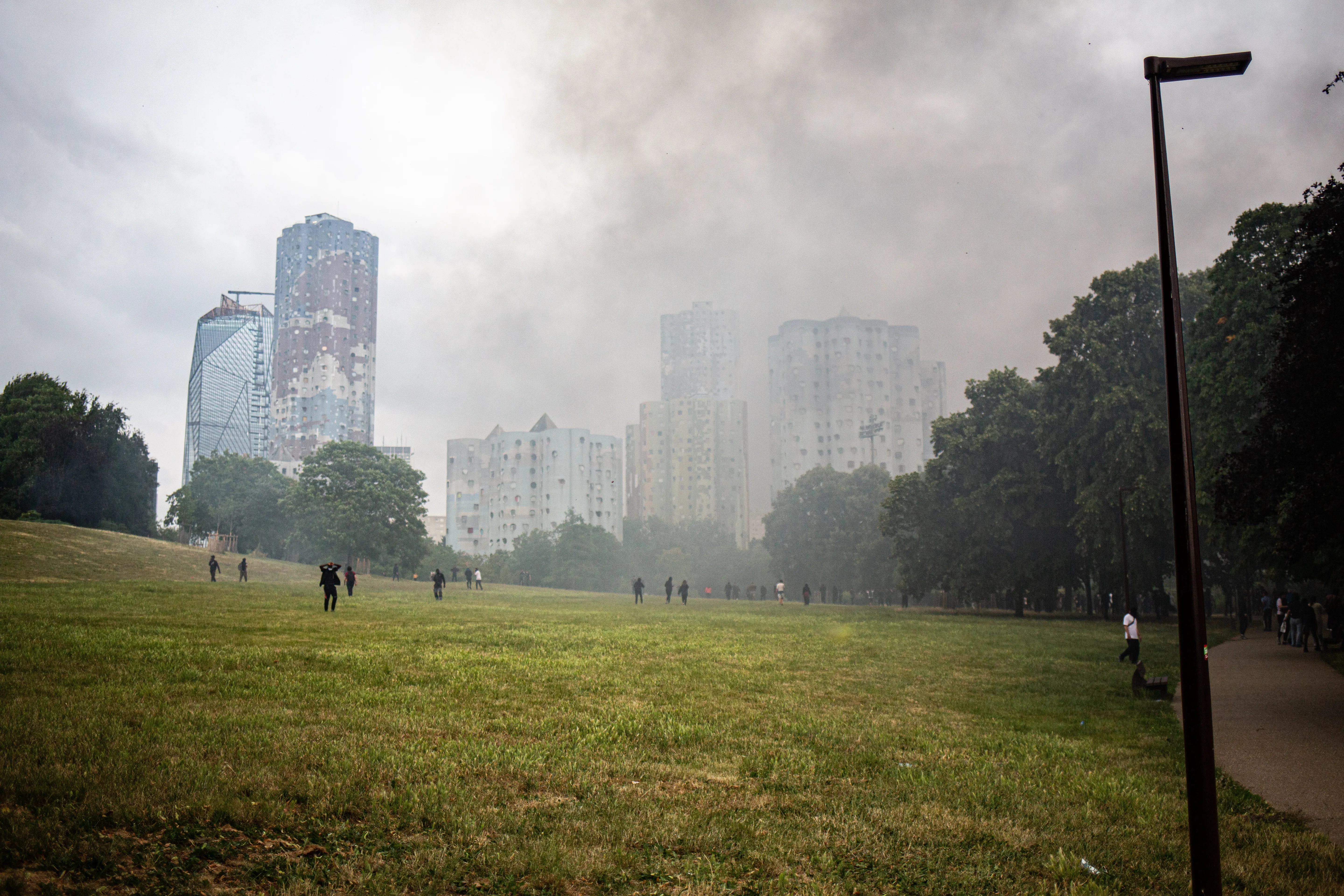
Day after day, proletarians living in these suburbs are subjected to state violence, whether in the form of the police (bullying, humiliation, slaps in the face at a checkpoint, beatings for a passing glance or a baggie of pot… murder is only the culmination of this harassment) or of the administration (family benefits advisors threatening to cut off allowances if you refuse to take the first underpaid job offered by France Travail, the lengthy appointments at the prefecture to regularize your ID, etc.). These routine practices remind them of their place in society. But they also generate obvious targets: the places where this violence is practiced (and, sometimes, the people practicing it). Under these conditions, it’s hardly surprising that “revenge” is the ideological transmission belt of their revolt. It is vengeance in the present and for the future because no horizon seems to emerge from the contradiction they inhabit, the contradiction of the proletariat as a whole.
The struggles of racialized proletarians thus reveal the general situation of the class, but because of their ideological character, they carry the particular content of police violence, lack of ID papers, Islamophobia and so on. The road taken by the class struggle is definitely full of pitfalls, but we will have to get used to it.
Based in France, Artifices is a collective that formed through the experience of common dissatisfaction following the autonomous movement responses to struggles in 2023 in France. The critical project is aimed at bringing communist hypothesis into existence.
Footnotes
-
We could mention the riots for Sullivan in Cherbourg in early 2024, Selom and Matisse in 2017, Adama in 2016, Moushin and Laramy in 2007, and so on. ↩
-
The powerlessness of the “people from the left” to get the pension reform abrogated was dispelled by the promise that, next time, we won’t let it happen, and that the movement had helped to recruit many new supporters, which would strengthen the fighting spirit of the class. Hope is life. ↩
-
Except in autonomous scene and insurrectionist circles, whose members we will not insult by assimilating them to the ‘far left’. ↩
-
Neighbors claimed that it was the police who fired the shots, but the investigators quickly buried the case. ↩
-
Médiapart, a liberal outlet, counted 6 people disabled and twice as many seriously injured, but these figures are probably underestimated https://www.mediapart.fr/journal/france/020823/l-effroyable-bilan-provisoire-des-violences-policieres-apres-la-mort-de-nahel ↩
-
The Watts riots broke out in a black ghetto in Los Angeles in August 1965 after yet another episode of police violence. ↩
-
Guy Debord, “The Decline and Fall of the Spectacle-Commodity Economy,” Internationale Situationniste #10, 1966: https://libcom.org/article/decline-and-fall-spectacle-commodity-economy-guy-debord ↩
-
Ibid ↩
-
“Address to Revolutionaries of Algeria and of All Countries” (Internationale Situationniste #10, 1966) in Situationist International Anthology, Berkeley, Bureau of Public Secrets, 2006, p. 192. ↩
-
Mezioud Ouldamer, Le cauchemar immigré. Enquête dans la décomposition de la France, Paris, Gérard Lebovici, 1986. ↩
-
Ibid ↩
-
The term ‘Frenchmen’ here does not refer to specific ethnic or national origins, but to ‘authentic’ individuals who refuse to take part in spectacle. ↩
-
Pre-restructuring cycle of struggle in the 1970s: the proletariat must gain strength through the workers’ movement and its organizations and assert itself as a class with a program and a workers’ identity, in order to achieve socialism. ↩
-
“If we go back only about twenty years, ‘national preference’ was the construction of a ‘racial’ group on the basis of criteria that were not ‘racial’; it was a matter of resistance to social relegation against those who were designated as its symbols and purveyors. It was in this way that the defence of ‘working class respectability’ became ‘national preference’, which was constructed on the basis of the criteria of working-class respectability as the delimitation of a ‘racial’ group to be fought against, and not as the affirmation of a ‘us’ like ‘France’, ‘the fatherland’, ‘Christianity’. ‘National identity’ was not a substitute for working-class identity; it was working-class identity that was “resisting” in the form of the national identity that had always been one of its determinants. ‘Resistance’ was not an anachronism, it had completely changed its content by reworking some of its determinations: from a desire to liberate labour from wage labour, it had become the affirmation, threatened as a social order, of wage labour as it ideally existed in the capitalist mode of production. Asserting oneself as a national, democratic and republican citizen meant conjuring off the anxiety of falling into precariousness and worrying about the future and asserting as inherent in citizenship the threatened ‘right’ to social advancement’.”; for more, see https://dndf.org/?p=21431 ↩
-
This remark refers to the French context, in which a certain number of groups, organizations and intellectuals perceive race as a mere employer’s mystification that can be ignored by the union of proletarians. The latter criticize any serious analysis of the materiality of racial divisions created and reproduced within the capitalist mode of production. Evoking the concept of race would therefore be racist in itself, and keeping one’s blinders on would be the only real revolutionary strategy. ↩
-
OS (ouvrier spécialisé) is a category of worker assigned to a specific task. It’s the typical Fordist factory worker. The expression “factory worker” would be the closest translation. ↩
-
Théorie Communiste, « Le kaléidoscope du prolétariat. De la segmentation raciale dans le mode de production capitaliste », TC #26, 2018, p.44. ↩
-
Certain excesses need to be tempered here: disjunction does not mean insurrectionary crisis, or even crisis at all, but a temporary discrepancy between two moments in the process of reproduction. Capital and its institutions do not stand idly by and watch the contradiction grow until it explodes. ↩