Dispatches from Mae Sot: A Town on the Thai-Myanmar Border
The author of this series, Wu Qin, is a Chinese anarchist who left the PRC in late 2022. Although she had long been interested in the Burmese revolution, it was not a focus of her research or activism (which had recently centered on the Iranian uprising of 2022), but when it became necessary for her to leave China, Thailand happened to be the country easiest for her to enter on short notice until she could move to a third country. While she was waiting, she took advantage of the opportunity to meet up with Burmese revolutionaries who had similarly fled to Thailand, and they recommended she visit Mae Sot.
By Wu Qin
A journalist by trade, Wu quickly became immersed in this town’s fascinating history and current role as a crossroads for political refugees and illicit commerce—a history that has led some researchers to call it an epicenter of “Dark Zomia” or “Zomia 2.0.”1 She took copious notes and recorded long interviews with young revolutionaries who had fled the junta’s counter-offensive in Myanmar, older refugees who had been stranded in Mae Sot for decades, migrant workers from as far afield as Tanzania, as well as Chinese entrepreneurs in the smuggling and online scam industries. Eventually she moved away, but was able to obtain a journalism grant that funded a return to Thailand a few months later, when she began further research and wrote the long-form Chinese story that forms the basis for this Heatwave series.2
Part I: First Impressions, 2023-2024
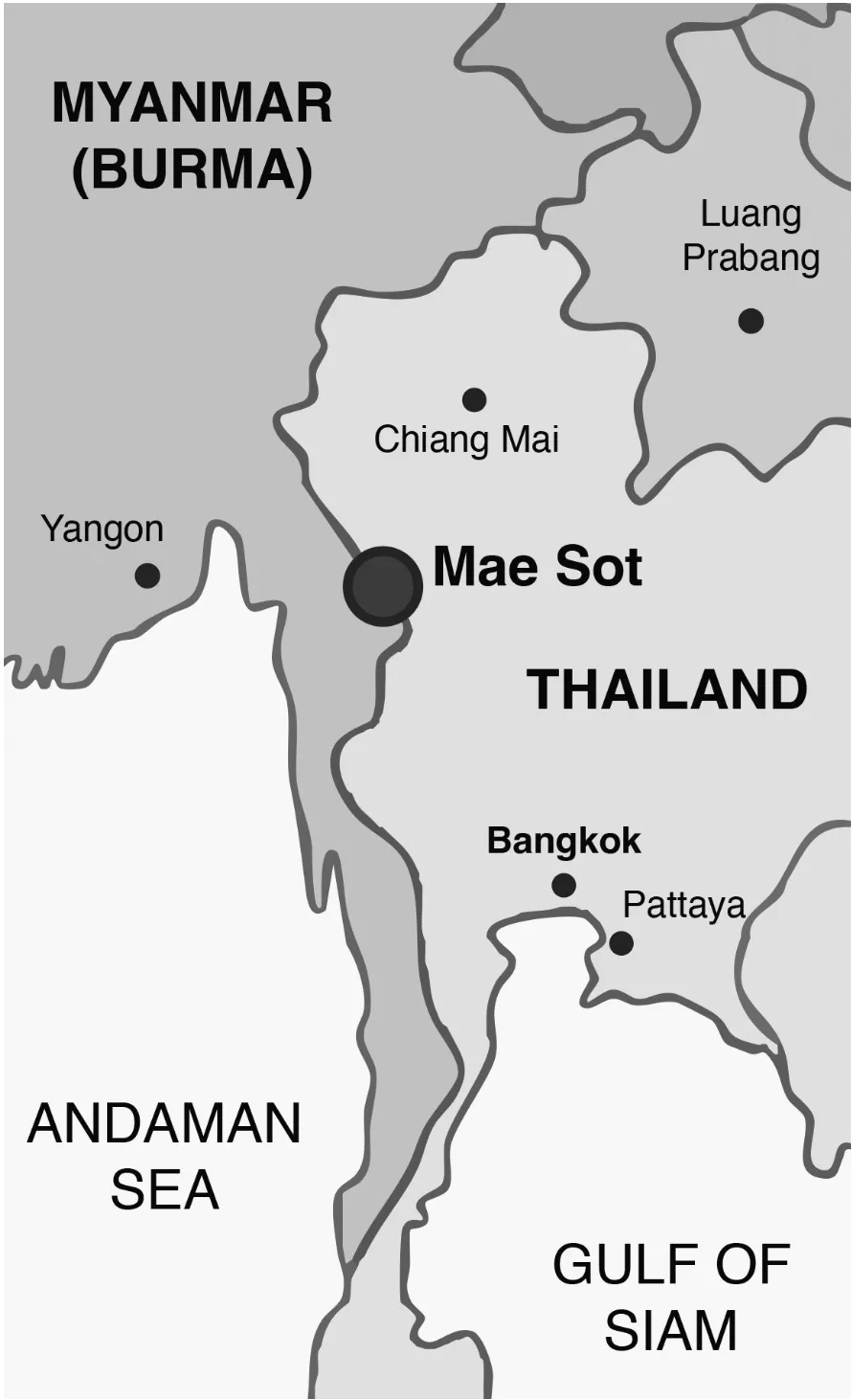
Mae Sot is a border town on the Western edge of Thailand, separated from Myanmar by the Moei River. Walking along the river, I could sometimes hear the soft singing of Burmese pop music, the chanting of sutras, or the roar of drones.
Across the river stretched the Thai-Myanmar Friendship Bridge built in 1997, connecting the two countries. Perched atop the bridge stood a border checkpoint; beneath it an informal market ran along both sides of the chain-link fence during times of the year when the riverbed was dry. On the far side you could hear hawkers calling out the names of various Burmese foods along with those of smuggled alcohol and cigarettes. On the Thai side customers would make their selections. The hawkers’ children hopped from one side of the fence to the other and back—each agile hop an “illegal border crossing.”
It was only after I had visited that market many times that I realized the hawkers were neither in Myanmar nor in Thailand, but on a patch of unclaimed land: a little sandbank situated between the two borders. It was home to stateless people without claim to any citizenship—some were Rohingya, displaced by ethnic cleansing in Myanmar but refused entry by Thai authorities; others were fugitives evading Thai or Burmese law, who had taken refuge on this exclave without a sovereign.
In a sense, Mae Sot is an extension of that little sandbank, where the concept of “nationality” is unsettled. It’s on the Thai side of the border, but it feels more like a Burmese city. People here speak Burmese languages, and most production and consumption take place around the flow of people originating in Myanmar. Few of them possess any official citizenship. Some are stuck in a legal limbo, holding various types of temporary documentation issued by Thai authorities. Others exist without any legal status, excluded from the modern order.
The Border and the Stateless
One could say that the border is like a prism, reflecting the flows and conflicts of the past and the present.
Zugar still remembers the difficult summer treks of his childhood, traveling from Yangon to visit his grandmother in Mae Sot. The family would first drive to Myawaddy, the town across the border, after which everything depended on luck. There was only a rugged, single-laned road from Myawaddy to Mae Sot, sometimes open for travel in one direction, sometimes in the other. At best, they could make it across in 24 hours, but often they had to spend a couple nights in Myawaddy first.
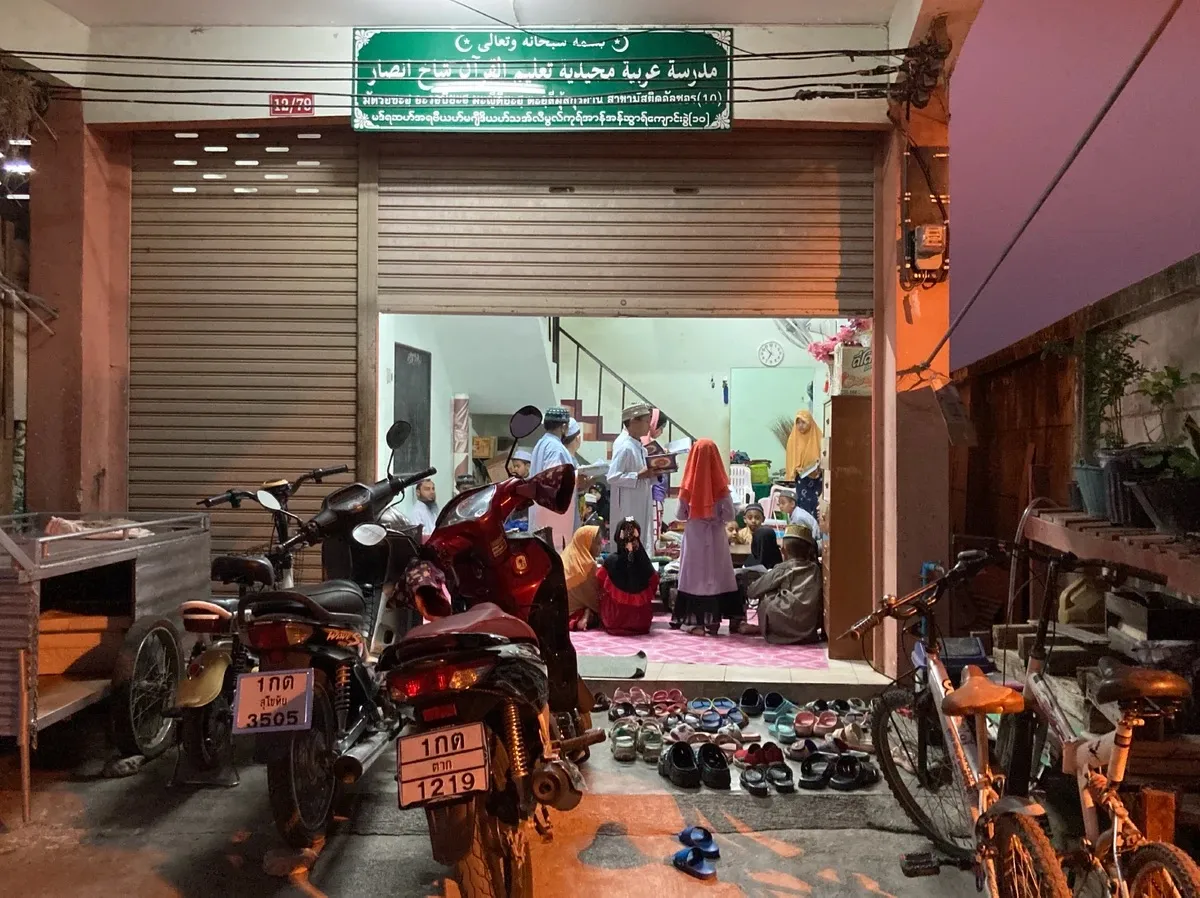
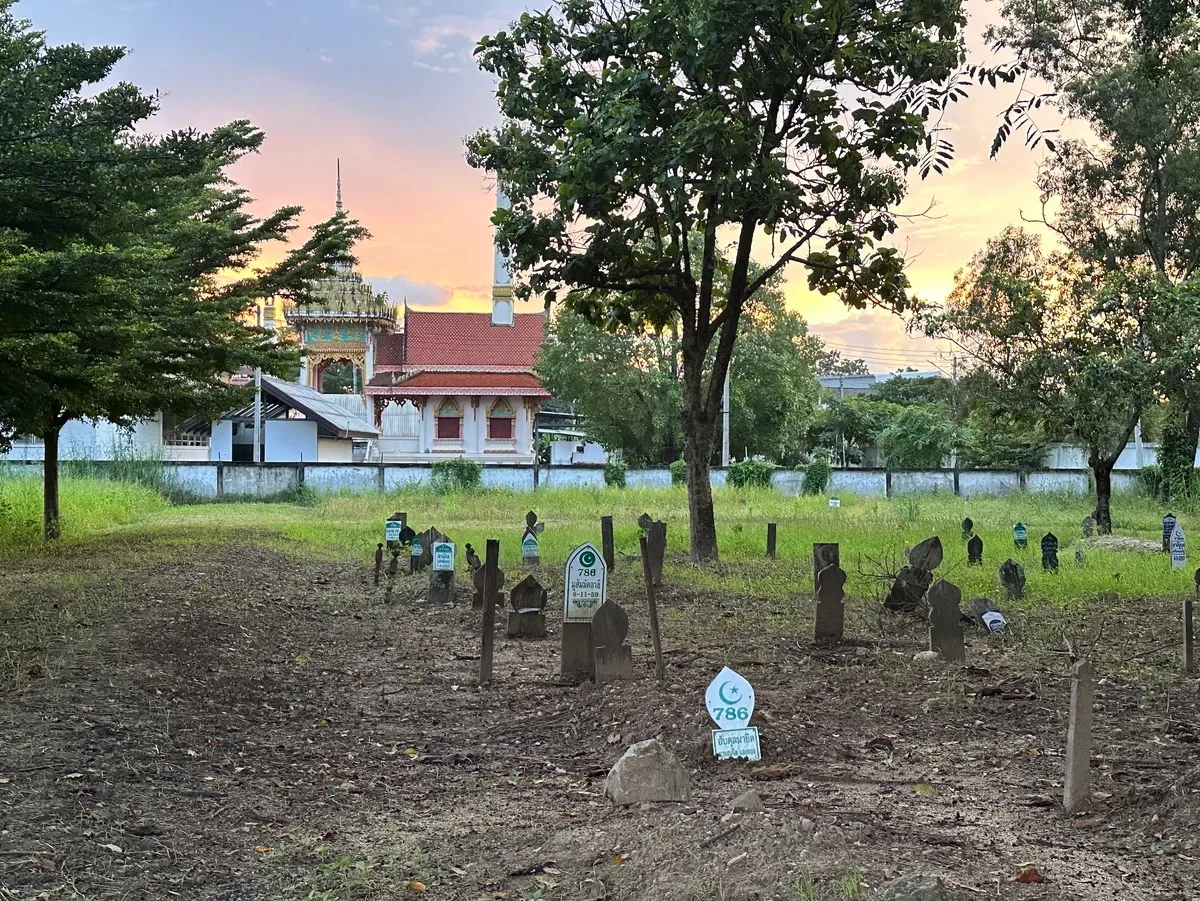
I met Zugar in Mae Sot’s Muslim neighborhood in February 2023. As one moves from the town’s markets to this neighborhood, the vivid colors characteristic of Southeast Asia grow dim. Streets become more rugged and the shacks more dilapidated, iron sheets and wooden planks only half-covering their living rooms. With few street lamps, an atmosphere of danger looms over the neighborhood in the evenings. Sounds of prayer and chanting drift through half-closed shutters. Incandescent light reveals children reciting the Quran, faintly illuminating the narrow streets. The neighborhood is rarely visited by non-Muslims—even the police are a rare sight, and the government has grown oblivious.
Zugar’s sister runs a food stall on the ground floor of the house where their family lives, selling a dessert called faloodeh. As legend has it, this dessert originated in the Persian Empire, spread to Myanmar through India, and later to China’s Yunnan province, each place adding its own local flavors. I had once sampled it in Yunnan, so was excited to taste it again here. As I chatted with Zugar over a bowl of faloodeh, he invited me to dinner at his home.
His mother wore a niqab covering her face, while his sisters wore hijab. Zugar sported a pair of retro square-framed glasses, his curly hair gathered behind a headband—a fashion sense that stood out in this conservative Muslim neighborhood. He was 27, working remotely as a programmer for a Singaporean tech firm. He described himself as “Burmese Bengali”—a somewhat paradoxical autonym, since in the context of Myanmar politics, “Bengali” is often used as an exclusionary label for the Rohingya. His mother’s parents had crossed the border as war refugees, and his mother and uncle were born in a refugee camp. Zugar was born in Mae Sot, but moved back to Myanmar as a child with his father, who was from Yangon. He spent his entire adolescence in Yangon until 2012, when an anti-Muslim riot broke out.
“We were terrified. In the Muslim neighborhoods of Yangon, we had young guys stand on guard 24/7 to protect the community from Bamar Buddhist rioters.” His family moved back to Mae Sot soon after. In contrast with the “economic exile” of migrant workers or the “political exile” of dissidents from movements against the regime (both contingents hailing from Myanmar’s majority Bamar population among other ethnic groups), Zugar describes his family’s status as “religious exile.”
That was the last time he had crossed this border, via the newly constructed Asia Highway, which brought them from Yangon to Mae Sot in only four hours. For ten years after that trip, he had been stuck in this town. Lacking any documentation, he had not even been to Bangkok.
Zugar had never possessed a nationality, and might not ever get one. As a Muslim, it is incredibly challenging for him to acquire Burmese citizenship. After the anti-Muslim riots, he sought asylum status in Thailand. After ten years, he finally received a “Stateless Card” in 2022, giving him legal status to stay in the country. But this status is not a path to citizenship—only his children could become “Thai.” Fortunately for him, Zugar was not alone: most people in Mae Sot were stateless as well.
Historically, Mae Sot has long been the first stop for refugees who flee to Thailand to escape the unending turmoil in Myanmar. Ever since the Union of Burma achieved independence from the British Empire in 1948, the federation’s Karen State, across the border from Mae Sot, has been in a constant state of war. This has displaced many refugees, alongside rebel forces who move between Mae Sot and the war zone in the jungles. Following the riots and Myanmar’s policies of systematic discrimination, Muslim refugees also started arriving, forming settlements connected to transnational trade. The mass protest movements of 1988 and 2007 also brought in Bamar dissidents from Yangon and other parts of Lower Burma.
The “Spring Revolution,” latest in the history of Myanmar’s oppositional movements, started after the military coup in February 2021. Within a week, hundreds of thousands of protesters flooded the streets of major cities, demanding the junta release its captive Aung San Suu Kyi, former State Counsellor and Minister of Foreign Affairs, and restore the democratically elected government. The younger generation came up with creative means of resistance, like banging pots and pans in symbolic demonstrations, flash mob protests and street performances. Civil servants resigned en masse in what they called a “civil disobedience movement,” while workers across the country launched general strikes. In response to the citizenry’s nonviolent resistance, the junta responded with violence in increasing severity, culminating in massacres and mass arrests.
Faced with this repression, the resistance moved underground. Many of the protestors fled Lower Burma for the jungles, some joining existing separatist forces known collectively as “Ethnic Armed Organizations” (EAOs), while others went into exile across the border. Mae Sot thus began absorbing another round of Burmese exiles.
For Muslims and Karen people in Mae Sot, national identities exist on a spectrum: the distinction between “Burmese” and “Thai” is arbitrary at best. Most of the political exiles do not have passports and are wanted by the junta. When asked, they clearly identify as “Burmese,” but since the start of their exile, they have lost their rights and identity as citizens of Myanmar. Most are unable to apply for Myanmar passports or return to the country without facing persecution. Some have applied for refugee status from the UN High Commissioner for Refugees (UNHCR) field office to go to a third country. Many of those who stay apply for the “Pink Card,” a labor permit issued for migrant workers, while others apply for the “Stateless Card” (also known as the “White” or “Hilltribe Card”), an identification document valid for ten years, designed for ethnic minorities on the border, by paying more to the agencies handling residency documents. Still others hide away in safe houses, facing harassment or extortion by local police if they go outside.
As Stephen Campbell points out in his book Border Capitalism, Disrupted, the Thai-Myanmar border synthesizes the promise of asylum with the practice of violence. People from Myanmar can cross the border when they face persecution, without having to formally apply for asylum under international law. However, the technologies of power on the Thai side of the border are aided by the junta tyranny on the other side, as the precarious condition of exile enables Thai authorities and businesses to exploit refugees for economic gain.
Since around 1990, more and more Thai factories have moved to Mae Sot to access the labor of Burmese workers, who can be paid less than the minimum wage. Mae Sot has thus become home to massive sweatshops staffed by Burmese migrants. Today, the town is the main base of production for the Thai garment industry. It had already been attracting cheap labor from Lower Burma for decades, also due to the demand for labor in construction and agriculture in surrounding villages. Every round of mass land confiscation in Myanmar by the junta, and every Western sanction imposed against military repression, has resulted in another wave of migrants and refugees flowing into Thailand.
For most of the displaced people, proper work authorization is too expensive. Those who are able to afford these documents move from the border to other cities in Thailand for better labor conditions. Those who can’t afford them have to stay in Mae Sot. The systems of production on the border thus form a brutal link in the chain of global capitalism, where Burmese migrants are treated as disposable lives. Here, workers are deprived of a social safety net, and they have very little time off work, if any.
Since the 2021 coup, state violence in Myanmar has reinforced the precarity of Burmese people’s lives in Thailand, facilitating extortion by Thai police, whose threats of deportation feel more serious under current conditions. From 2021 to 2023, over 50,000 people flowed into Mae Sot from Myanmar. Without legal status, they became magical money trees for local police, who stop and frisk Burmese people on the streets and threaten them with deportation or detention. The lucrative gray income has made Mae Sot one of the most desirable places for Thai police from throughout the country, creating fierce competition for law enforcement jobs in the city.
The Burmese town across the border, Myawaddy, has become fairly well known in China through its association with telecom scamming compounds. Horror stories of Chinese victims being abducted, enslaved, or subject to kidney harvesting have attracted significant attention from the public. In reality, more of the people trapped in these compounds come from the bottom of Myanmar society, whose impoverishment only worsened after the coup. As many had never been recorded in official registries and no one could claim their bodies, their lives are not considered newsworthy.
On the border, almost everyone feels the perpetual presence of Myanmar’s state violence through its absence. While I’ve never been to Myanmar, in Mae Sot I found myself growing immersed in Myanmar’s cityscapes, its rugged hills and flowing streams.
The Road to Exile
On my phone, there are pins all across the border on Google Maps, marking the routes taken by young exiles of the Spring Revolution. This was one of my favorite topics of discussion in Mae Sot: they would tell me one geographical name after another as I recorded them on my map.
Yet, no matter where they departed, or which route they took, they all eventually ended up in Mae Sot.
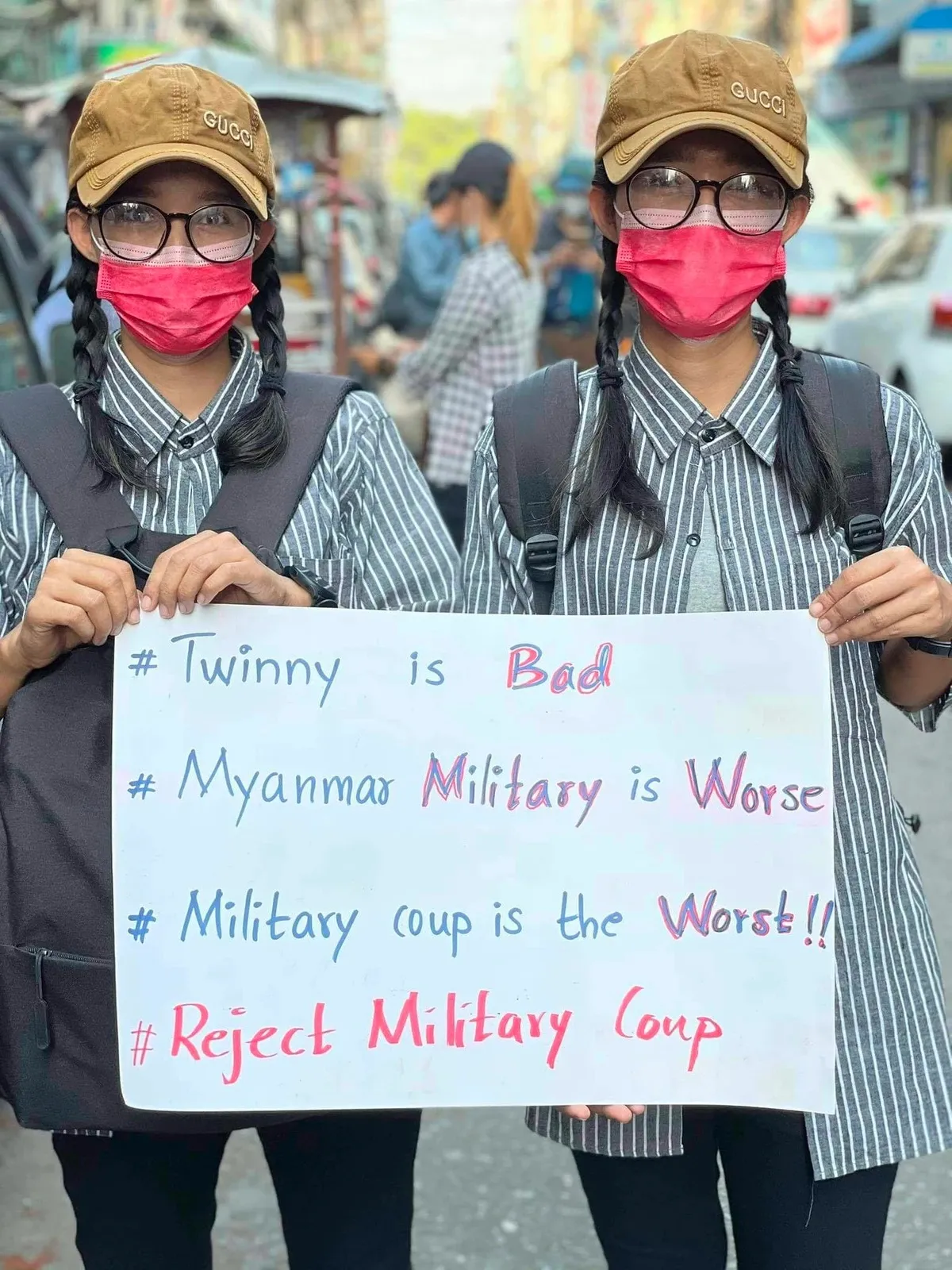
When I first met Waso and Pyartho, I was struck by their incredibly similar appearances: both wore glasses with black frames, had braided hair, were elegantly dressed and spoke fluent English. I had a hard time telling them apart even after we became good friends. When I met them in February 2023, they had just arrived at Chiang Mai, Thailand’s second-largest city. They had been stuck in a safe house in Mae Sot for a month due to their undocumented status. Now that they had obtained work permits, they were excited to be able to walk around town every day, shopping for supplies.
These twin sisters came from a Muslim family in Myanmar, where they had worked as public school teachers in Yangon before the coup. They left their jobs in the Civil Disobedience Movement (CDM), which called for state employees to quit their jobs. The movement was initiated by Yangon healthcare workers, hitting its peak when 400,000 state employees joined, about half of whom were teachers.
After quitting their jobs, the sisters started to engage in underground activities. After surviving two years of heavy repression, a friend in their activist group was arrested by the military. Everyone else fled the country. “We all agreed: if anyone were arrested, they should just give the interrogator the list of names—nobody ought to endure the torture that would be inflicted otherwise.”
Waso and Pyartho could not get passports because they were wanted by the junta. They had no option but to smuggle themselves across the border, like many of the other protesters. They followed the smugglers from Yangon, switched vehicles and crossed the entirety of Karen State. But just as they crossed the border and got on the smuggler’s motorbike, Thai police showed up.
In a panic, the sisters started speaking in Korean—the “secret language” they had learned by binge-watching K-drama for years. After a moment of confusion, the smuggler told the police in Thai that the sisters were probably Rohingya. Convinced by their South Asian appearance, the police took them to detention alongside the smuggler.
For many years before the coup, Mae Sot had already served as a point of transit for Rohingya refugees fleeing ethnic cleansing in Myanmar. Many hid in the town’s influential Muslim community. Most would not stay long before moving to Malaysia via a network that connected them from the northwestern border to the Muslim-majority regions in southern Thailand. Very few of the Rohingya refugees stayed in Mae Sot or joined local Muslims in trading second-hand cars, teakwood and gems in local markets. If at any point they were arrested, Thai authorities were likely to deport them for crossing the border illegally.
The exiles of the Spring Revolution enjoy a somewhat safer status than other refugees in Thailand. Facing international pressure, the authorities have agreed not to repatriate dissidents who fled Myanmar. Over the course of two years, the tens of thousands of resettled Burmese dissidents constructed an extensive safety net involving the democratic government-in-exile known as the NUG,3 grassroots organizations, international NGOs with programs focusing on Myanmar, and the UNHCR. News and funding circulate within this network so that when a comrade faces difficulties, the community can help them out.
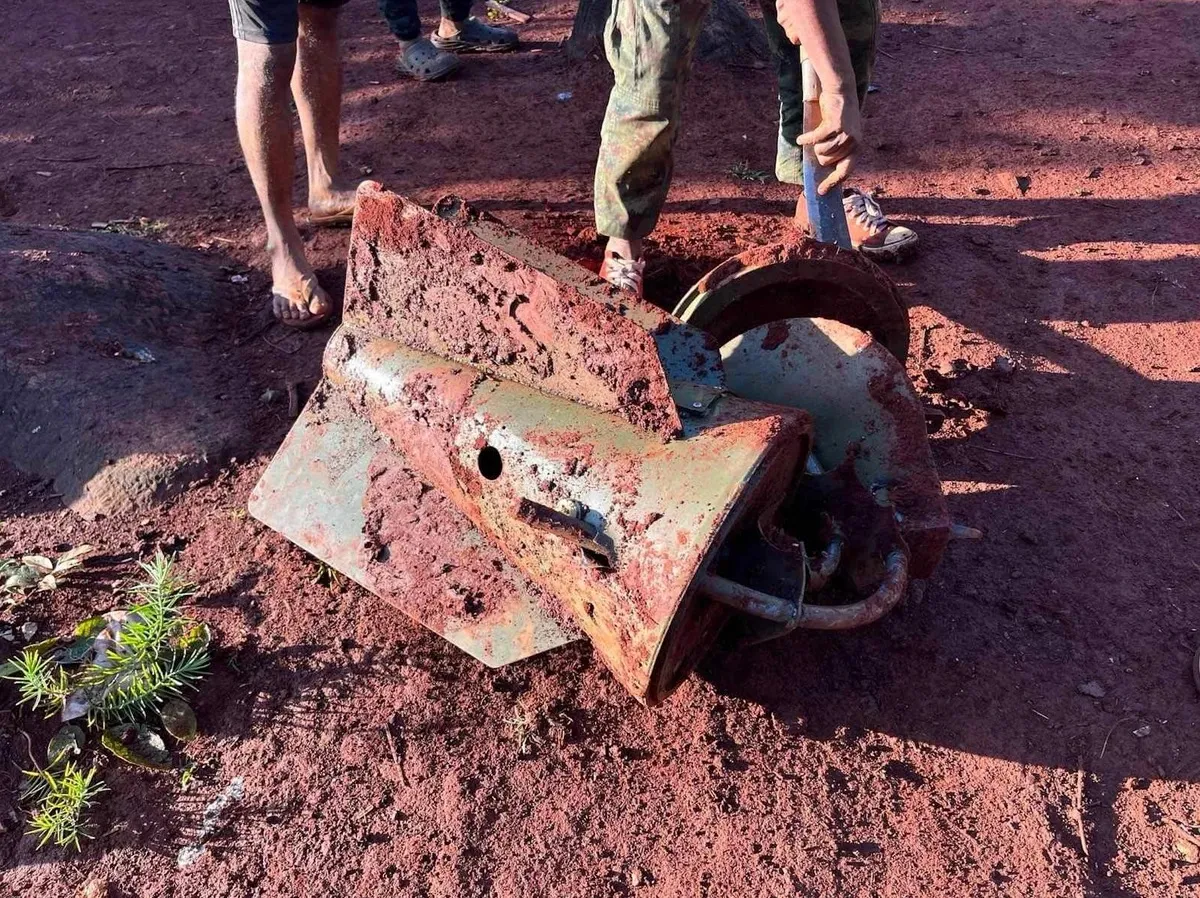
The twin sisters were rescued by this safety net, just a day after they were detained.
For Thein Tun, another native of Yangon, the journey to Mae Sot was much shorter as he departed from Karen State. Like many, Thein Tun had joined the People’s Defense Force (PDF) after the coup and begun training under the Karen National Liberation Army (KNLA) in the jungle camps near the border. After his son was born, he quit the PDF and went into hiding.
In February 2022, Thein Tun decided to leave the Karen jungle with his family. In contrast with the twin sisters, he was fortunate enough to avoid police, but he also lacked assistance, so he had to cross the border with his wife and child, together with some 30 Rohingya refugees and Burmese migrant workers. Through conversation, he discovered that the latter were headed for different destinations than the revolutionaries: the Rohingya were on their way to Malaysia, while some of the workers planned to work in Mae Sot’s garment factories, others hiding in cargo trucks bound for the industrial port city of Mahachai, where the seafood industry thrives on undocumented migrant labor from Myanmar. As for the Spring Revolution exiles, in order to understand how so many ended up in Mae Sot, we need to rewind the tape two months to a town across the border: Lay Kay Kaw in Myawaddy township, where the largest and riskiest wave of escape began on December 15, 2021.
Lay Kay Kaw was once known as “the town of peace.” It was built with the support of Japan’s Nippon Foundation during the 2015 democratic transition, after the military had signed an armistice with the KNU (Karen National Union) in 2012. The town was meant to provide accommodation for Karen people who had been displaced by the decades-long conflict. Before the coup of 2021, there were more than 4,000 Karen villagers in the town.
After the coup, Lay Kay Kaw became a “liberated zone” for a variety of revolutionaries. Thousands of young protesters came to this town under the KNU’s protection as they fled junta rule. Most planned to join the PDF as guerilla fighters, responding to the NUG’s rallying cry. The town became a supply station and transit stop for the Ethnic Armed Organizations training in the jungles. There were also dissidents, journalists and former representatives of the NLD (National League for Democracy) government, who came to Lay Kay Kaw for temporary refuge.
For the parents and brother of Saw Marner, a young Karen revolutionary, Lay Kay Kaw has been home since construction finished in 2015. Like many Karen villagers, they welcomed the protesters and dissidents who arrived from Lower Burma after the coup. Almost every villager had a protester in their homes before the military’s final assault. Some even rented out their Japanese-built houses to the urban middle-class visitors and moved into shacks they hastily constructed on farmland.
Ko Tin Maung had been an engineer in the Thilawa Special Economic Zone in southern Yangon. He was one of the first people to flee to the Karen jungles after the coup. After two months of military training, he realized that he wasn’t suited for frontline work, so he set up a school and a library in Lay Kay Kaw for local children. At first, only four children attended the school; this number rose to more than 70 just before they had to flee again. Aside from academic courses, he also led the children in physical fitness exercises. He sent me a couple of videos of him playing games with the children, adding “I miss my kids. Lay Kay Kaw was like a utopia.”
Mg Saint is an experienced anarchist activist from Yangon. After the coup, he worked with the General Strike Committee. Due to his decade-long engagement in social movements, he was quickly identified as a “fugitive” on junta-controlled TV broadcasts. They accused him of killing a soldier. His home in Yangon was raided by the military, and his wife and kids went into hiding. He and his comrades at the Committee fled into the Karen jungles.
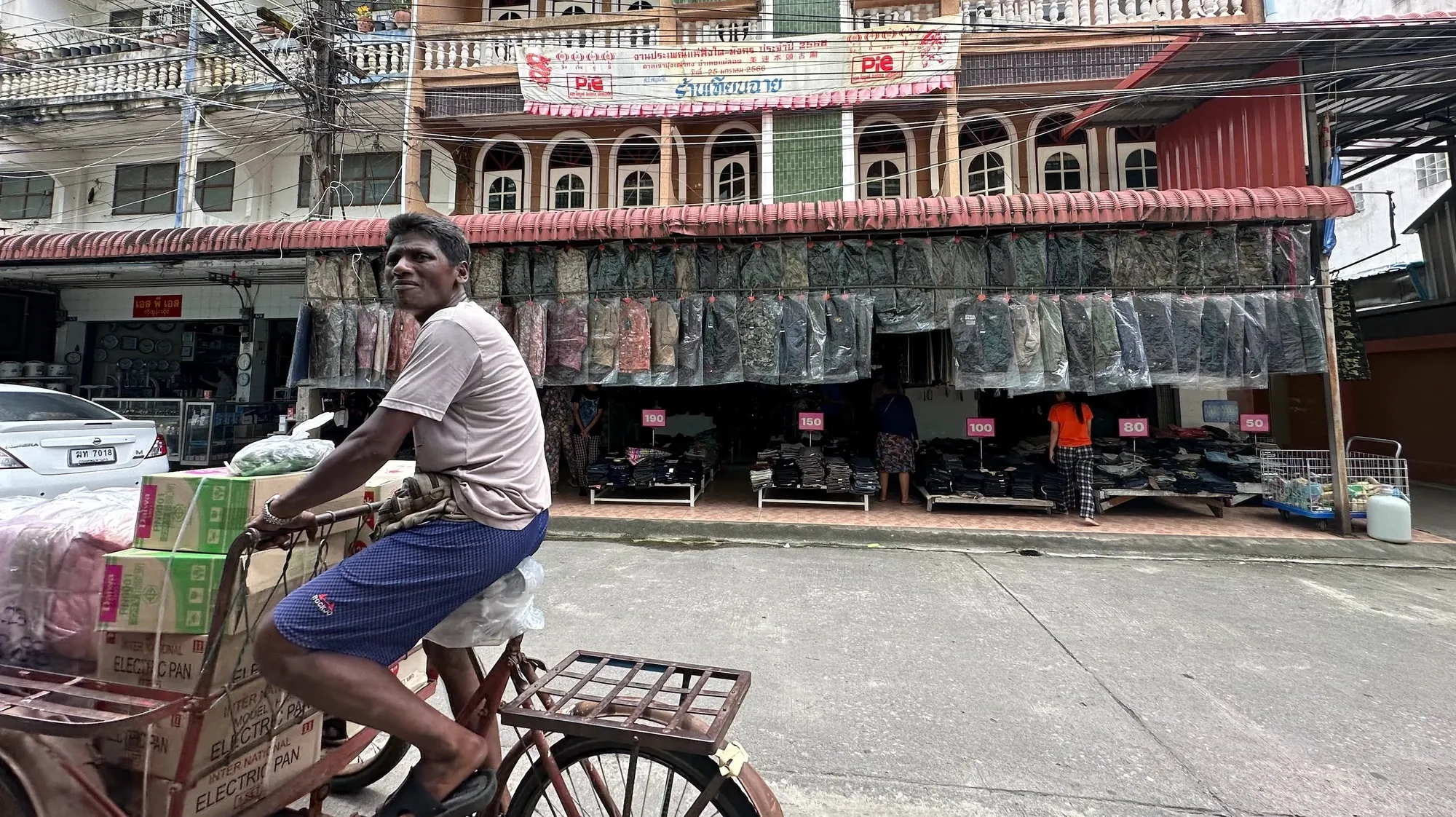
Everything came to an end just a month after Mg Saint had settled in Lay Kay Kaw. The military assault started on December 15th, 2021. The “town of peace” had become a hub for the arms trade after accommodating more and more guerrillas, and this had attracted the junta’s attention.
At first, the villagers did their best to cover for the revolutionaries. However, the military soon began indiscriminate air raids. Tens of thousands of people dispersed in an instant, setting out on their paths to exile. Some of the elderly villagers and children couldn’t escape in time and were killed in the bombings.
There was no phone service along the border, so a lot of people lost contact with each other as they fled. Ko Tin Maung remembers a friend who lost track of his wife and three children, the youngest only four years old.
Refugee camps and villages lined both banks of the Moei River, long-term accommodations for Karen people displaced by war. Saw Marner’s parents and brother settled in one of these villages. But the protesters from Lower Burma had to constantly move back and forth across the river. Villagers would ask them to leave just as they were getting settled, as their presence would attract military drone strikes. But when they went to the Thai side, they would find themselves forced back to Myanmar by Thai border forces or refugee camps that refused to take them in.
“Many camps were involved with the underground arms trade. We don’t know which side they’re on, if they supply weapons to the junta or their allied Ethnic Armed Organizations,” Mg Saint said, adding with a bitter smile, “We haven’t seen a single one of the welcome signs that the UNHCR claims to have installed.”
After two weeks on the road, Ko Tin Maung and his friend found an appropriate place to cross the border. The friend managed contact his wife when they arrived in Mae Sot. She thanked Ko Tin Maung for setting up the school in Lay Kay Kaw and helping the children get in shape: they couldn’t have survived the journey otherwise.
Just as they settled down at a camp next to the river, Saw Marner’s mom passed away, but they couldn’t hold a funeral for her. A couple months later, his brother sneaked back into Lay Kay Kaw, wanting to take one last look at the house they had hurriedly fled. The house had been plundered clean—all the furniture and appliances were gone. A few months later, the “town of peace” was under complete military occupation.
Footnotes
-
“Zomia” is a term for the border regions of highland Southeast Asia popularized by James Scott, who argued (in The Art of Not Being Governed, 2009) that Zomia was historically defined by intentional autonomy from state control. The term “Dark Zomia” was used in the title of a keynote speech by anthropologist Pinkaew Laungaramsri to frame the International Conference on Myanmar’s Borderlands at Chulalongkorn University in June 2024, which included several presentations on Mae Sot. There, “dark” was meant in a derogatory sense to emphasize the role of organized crime in such border towns. The term “Zomia 2.0” has been used in a broader sense to describe these towns’ semi-autonomy from the state regulation of commercial activities more generally, the term being coined by anthropologist Alessandro Rippa in his case study of a Laotian SEZ (“Zomia 2.0: Branding Remoteness and Neoliberal Connectivity in the Golden Triangle Special Economic Zone, Laos,” Social Anthropology 27/2, 2019). While Scott had concluded that the region’s historic autonomy had ended by the 2000s as its inhabitants were incorporated into various states, Rippa asserts that some relatively well-placed Zomians have revived their efforts to escape state control by resorting to “neoliberal” methods: buying some degree of autonomy “in exchange for political recognition, development of infrastructure and the possibility for those in power to accumulate hidden fortunes” (p. 255)---often involving the exploitation of less fortunate members of their own communities, or workers trafficked from elsewhere. Wu is not satisfied with either of these framings, but it’s worth noting that this is how academics have been theorizing the region. ↩
-
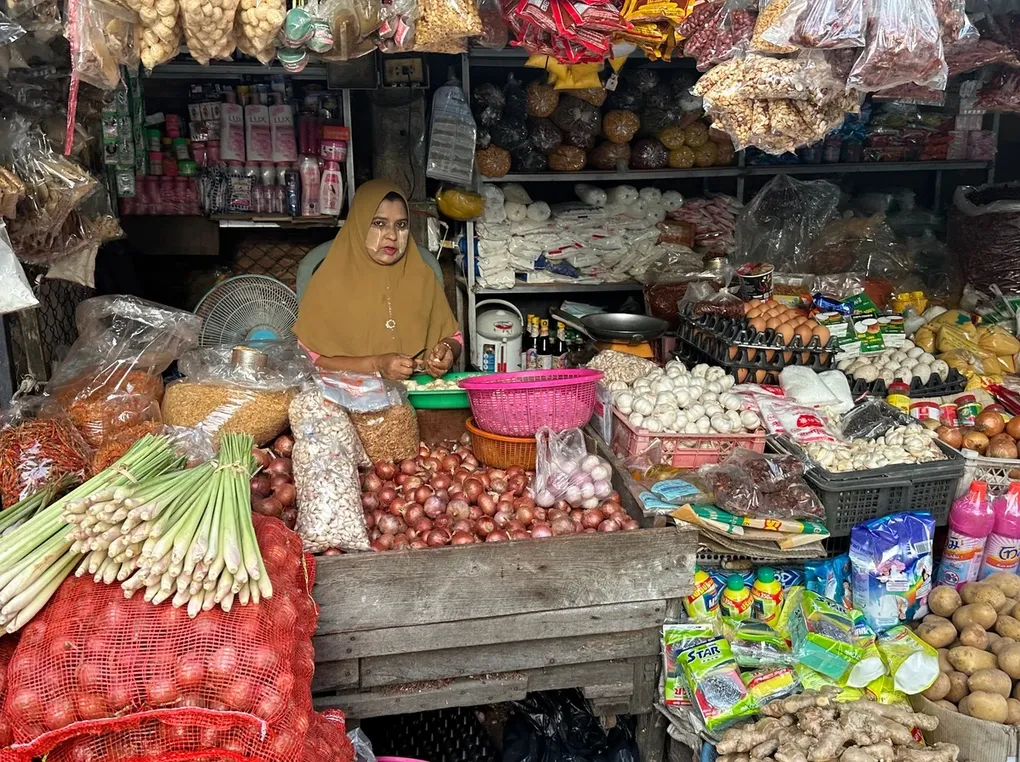
Diego Ge’s English translation of the story was published as “Between Borders: The Spring Revolution and Burmese Exiles on the Thai-Myanmar Border” on the funder’s website (frontlinefellowship.io). They’ve generously offered to let us use revised and abridged portions of that translation in this series. In addition, Wu will be incorporating updates based on later visits to Mae Sot and communication with her contacts there. For another English text by Wu Qin, see “An Embassy’s Blood, a March in Beijing, and Chinese Intellectuals in 1999” (Chuang blog, 2023). Header image: A Burmese Muslim vendor at a market in Mae Sot. All photos by Wu Qin unless otherwise specified. ↩
-
The National Unity Government of Myanmar (NUG) was formed after the 2021 coup by members of the National League for Democracy, Ethnic Armed Organizations, and various other minor parties. It currently operates from both within and outside of Myanmar, with an affiliated military wing known as the “People’s Defense Force” (PDF). For details on the federalist NUG/PDF and their tensions with separatist tendencies in the revolution, see “Unhappy is the Land that Needs Heroes” by Geoffrey Rathgeb Aung (Chuang/Endnotes, January 2025). ↩