Beneath the Bocage, the Bank
The Commune Form: The Transformation of Everyday Life is but the latest in Kristin Ross's catalog of contributions on the subject of 'territorial struggles'
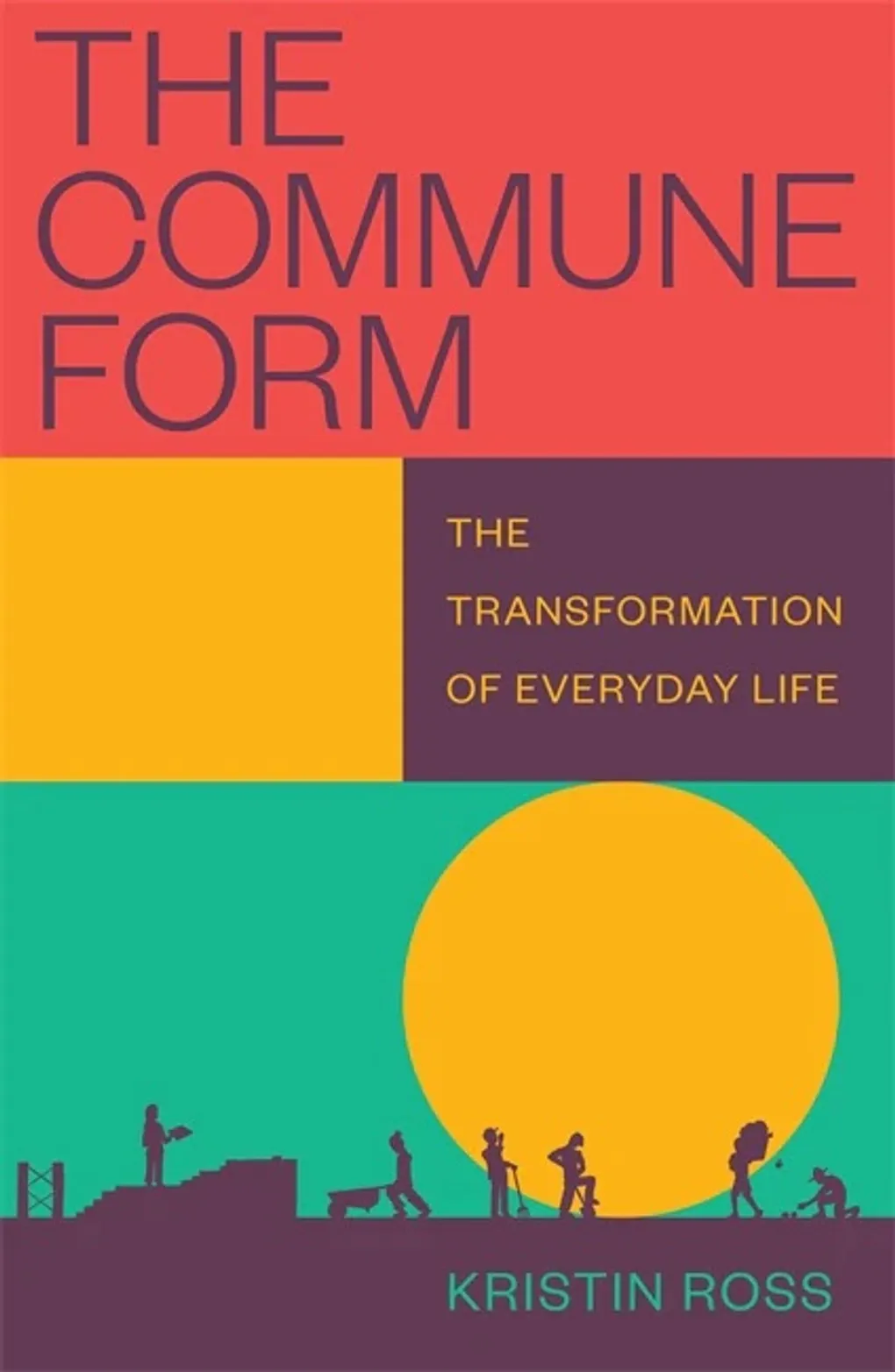
by F.P.
“No New Mega Airport!” Exasperated yard signs peppered the southeast of corner of the Puget Lowlands in western Washington, an area of scattered lakes, estuaries, and floodplains dissected by inlets and rivers. This idyllic landscape had been slotted to host “the Airport of the Future.” Sea-Tac airport is projected to reach capacity by 2032, a shortfall that will devolve primarily on central and eastern Washington residents, who may lose air transit services altogether. A new airport was supposed to rectify this geographic discrepancy by sacrificing rural and exurban zones at the altar of development. The clear urban bias of the whole project did not escape notice of residents, who organized under the banner of “Stop the Airport.” Such a project would devastate wetlands, watersheds, waterways, prairies, and old-growth forests.
This airport proposal came across my radar on a drive, in all likelihood on my way to a nearby forest, river, or mountain, surely a clichéd image of the urban-dwelling Pacific Northwesterner. The yard sides were not exactly eye-catching by design. What I noticed was their frequency. It appeared as if residents had achieved unanimity in opposition to the airport. Their reasons were many—displaced families, razed homes, lost livelihoods, destroyed habitat, polluted drinking water—but their rallying cry was streamlined, succinct, and marketable: stop the airport. I open with this project to highlight its ubiquity. 2025 is set to be a banner year for large air-transit-related construction projects, with investors and fund managers watching like hawks for public-private partnership opportunities. Predictably, almost half of these developments are planned in the Asia-Pacific region.
Beneath the Bocage, the Bank
In her 2024 book The Commune Form, Kristin Ross identifies this expansionism as the logic of the “airworld,” with air transportation growing in importance as international trade substitutes for manufacturing growth. The airport is the “symbol… of state-imposed infrastructural projects,”1 which have come to characterize the epoch of capitalist development that lurks in the shadow of the postwar boom. The most consequential battles between labor and capital no longer take the form of an urban workers’ movement waging economic struggles against the bosses, but instead find expression in the figure of the world paysannerie (“peasantry”), defending rurality and associated ways of life against dispossession by the (capitalist) state. This struggle has not been foreclosed; if you know where and how to look, you can see it carried on today, in far-flung places, bearing idiosyncratic and localized characteristics. We just need tools of analysis adequate to the task. This is the basic gambit of The Commune Form, its strongest asset and, as I hope to show, its primary liability.
The Commune Form is but the latest in Ross’s catalog of contributions on the subject of “territorial struggles.” She turned attention to “the commune form” first in her 2015 book Communal Luxury: The Political Imaginary of the Paris Commune (Verso), which noted the international “return of an occupational form of protest” in the early 2010s, taking this seriously as a contemporary echo of the Paris Commune of 1871—what Marx had famously called “the political form at last discovered” adequate the economic emancipation of the proletariat.2 This was for Marx the “secret” of the Commune: as a form, its “actual working existence” made possible the historical process of communist construction. The hard lessons that it taught, specifically the contradiction between town and country, greatly influenced the course of Marx’s unfinished later research. Among the truths brought to the surface by the counterrevolution was the need to overcome the contradiction between mental and manual labor and the necessity of territorial expansion. For Ross, this signals the importance of territorial defense and rural life. If capitalism survives through the annihilation of space by time, then struggles to defend space present it with a terminal threat.
From Unist’ot’en to Tahrir to Gezi Park, defense of particular places has become a hallmark of the present. In her new book, Ross calls this a “new political intelligence,” land as the focal point of revolutionary thought in the present.3 The commune form today possesses the capacity to resolve what Ross recognizes as the primary contradiction of modern life: alienation from the land. “Capital[‘]s real war is against subsistence,” is one of her more lucid and portable assertions.4 Dispossession from the means of subsistence creates a “gap between life and its conditions.”5 This fundamentally metabolic separation gives capital its characteristic “mute compulsion,” that drudgery of existing between the carrot and the stick. Following Henri Lefebvre, Ross argues that the only possible response is the “transformation of everyday life” in ways that appropriate space and daily rituals and defend them. The commune form emerges at the opening created by the [“]contradiction between the logic of development and the logic of living.”6
Following the publication of Communal Luxury, Ross visited the ZAD (“zone to defend”) in Notre-Dame-des-Landes. Invited to discuss the Paris Commune*,* she developed contact with the Mauvaise Troupe Collective (MTC), a group of occupiers who had become something of a theoretical mouthpiece for both the ZAD and NoTAV.7 MTC argued that creating and defending territories brought together various stakeholders—what they called “components of struggle.” The challenges of existing together in a territory gave these otherwise siloed and divergent strands a common task of social transformation—the emergent property they came to call “composition.” Ross translated their manifesto of sorts, The Zad and NoTAV: Territorial Struggles and the Making of a New Political Intelligence (Verso, 2018), providing a preface as well.
Commune, territorial struggle, composition—these terms are difficult to parse and have been examined critically elsewhere.8 The commune form is supposedly all of these and more, the emergent property of these struggles in motion: “at once a political movement and a shared territory, a tactic and a community-in-the-making… nothing more than an attempt to gain ground in the historic fight against enclosure.”9 She traces concepts such as “temporary autonomous zone” (TAZ) and movements like Standing Rock through the long romantic history of left efforts to “defend the territory” against capital and its world, arguing that each iteration has expressed some aspect of the commune form in material reality. Still rooting her argument in Marx’s assessment of the Paris Commune, Ross’s focus is the “actual working existence” of the form in practice. This focus on “political intelligence” as a function of practice is one of the many assets of her work. If one thing leaps from the pages of the book, it is her commitment to participating in and interpreting cycles of struggle in the unfolding ecological crisis.
The last decade of struggles has seen ecological militancy emerge from the shadow of the left, although it continues to occupy an awkward position vis-à-vis traditional labor struggles. The cliché that environmentalists don’t care about workers, threaten job growth, or condescend to rural life still persists, with some truth and much exaggeration. We don’t need to go as far back as the timber wars or the northern spotted owl controversy: union support for the Dakota Access Pipeline and opposition to the struggle at Standing Rock demonstrates the point well enough. Ross claims that the commune form transcends this apparent tension by unifying the reproduction of daily life with reconnection to the land, nevertheless ignoring lineaments of class, race, or indigeneity.10 She explains rural militancy as a fight for survival, a revolutionary form of life in a dying world. In a recent report on Les Soulèvements de la Terre (Earth Uprisings), Ross is at pains to distinguish its collective form from earlier, more diffuse and clandestine cycles of environmental radicalism. “Compositional struggles,” wedded as they are to daily life, have a mass character that allows militants to carry out popular destruction of earth-destroying machinery “in broad daylight.”11
The commune “does not lend itself to a static definition, unalterable through time.” This flexibility allows for “local experiments that refuse to be defined by a localist chauvinism.”12 Localist chauvinism, or what Neel and Chavez call “local autarky,”13 is a specter that Ross clearly wants to avoid. To invert it, she turns to the figure of the peasant (or paysan, as Ross prefers to say14) to make the case that the future of revolution turns on rurality and the perspective of subsistence. This figure is not a local phenomenon, but a general, world-historical revolutionary subject, produced through capital’s war against subsistence. She follows the thought of Bernard Lambert, a paysan whose experiences in the 1968 Nantes Commune and a sheep farmers’ struggle on the Larzac Plateau, along with close observation of the Lip factory occupation of 1973, led him to found the Paysans-Travailleurs (worker-peasant) alliance and advocate an “anti-productivist” form of self-management he described as the [“]marriage of workers and paysans, the marriage of Lip and the Larzac.”15 For Lambert, the peasant was the “defender of the earth.”
The peasantry fulfills this function because it inhabits the perspective of subsistence and lies beyond the metabolic yoke of the capital relation. On the other hand, it is this expanding separation that generalizes the peasantry as a “distinctly new revolutionary subject.”16 Ross thus finds her position treading a treacherous wire. We are told the commune is a struggle for subsistence outside the circuits of capital. Inverting Tronti’s maxim “within and against,”17 for Ross the commune’s real practice of reproducing daily life is sui generis, external to and therefore against capital. It works because it is literally a world apart. Hence, the ZAD’s rallying cry “against the airport and its world.” But what if that world, the “airworld” of capital, has completely enclosed and disturbed the planetary metabolism?
In an excellent review, Kevin Duong predicts that Ross’s flirtation with romantic pastoralism is something for which she will not be forgiven, given leftist anxieties surrounding populism and a supposed contempt for rural life, but such flirtation is necessary: while “the paysannerie might be backward, defunct, reactionary, even anachronistic… they have also been fighting for everyone[‘]s future.”18 If we follow Ross in taking paysannerie to extend beyond the world’s few remaining self-sufficient smallholders to include most inhabitants of capital’s rural hinterlands, Duong’s “backwardness” claim is too broad to have much meaning. To claim further that this motley rurality share common interests and fight for a common future is simply absurd. If the “perspective of subsistence” describes the peasantry as a class, this can be tested against the history of capitalist development. This is where the book’s conception of the commune form becomes untenable.
Like many before her, Ross essentially conflates capitalism with urbanization and industrialization.19 If, however, we understand capitalism as fundamentally an agrarian revolution, the 20th century comes into view as a massive de-agrarianization and capitalist transition, unfolding most rapidly during the postwar “Big Push” toward industrial modernization and coming to fruition only toward the end of the century. Even in France, fully capitalist, mechanized agriculture did not characterize the sector until the decades between 1945 and 1973. Curiously, it was at the close of this period that Lambert declared the peasantry to be on the side of the communards, when there was no longer a peasantry to speak of. The unfortunate reality, for the vast majority of the global population, is that [“]We… live in a totally capitalist world. There is no capitalization of agriculture to accomplish, no ‘peasant’ question for the workers’ movement.”20 Capital has inherited the earth.
In this context, for Ross, MTC, Earth Uprisings, and the like to envision the primary struggle as “life against development” or “subsistence versus productivism,” they must elide questions of class and property. They are therefore unable to clarify the social relations that subtend their own categories, whether rural or urban. It is only on the basis of these concrete relations that we can judge the communist character of a given struggle, that is, how it catalyzes communist measures.21 Ross misses the trees for the forest, discounting differences in social content, subsuming anything from indigenous land defense to farmer protest under the general form of the commune.22
The indeterminacy of the struggles surveyed by Ross can thus be resolved only on the level of function, which Ross disavows in favor of form—one that ultimately turns out to be formless. Consider the Sanrizuka struggle against the Narita Airport in 1960s Japan alongside the post-2008 occupation of the ZAD. For Ross, their formal similarity expresses the truth of the Long 1960s. However, if we acknowledge capitalism’s basis in agrarian revolution, we can recognize their distinct contents: the first a struggle against capitalist transition, the latter against rural redevelopment, property loss, and asset deflation in the context of capitalist decline.23 By attempting to unify disparate conflicts, Ross’s formalism itself breaks down. Some examples, like the early forest occupation in Atlanta, support her case about territorial defense as occupation and reproduction of space. Others, like the mass actions of Earth Uprisings, do not share this form, but share the “compositional” features and repertoire of tactics. How do we reconcile a formalism with no particular form? If we return to her definition, the general historic fight against enclosure is supposed to subsume these particular differences, a meta-form, so to speak. That might work, if that meta-form had any historical content. But, as we have seen, it lives only as anachronism.
In her commitment to methodological formalism, Ross mystifies the role of territorial struggle today. Instead, I contend that the “commune form,” if this category is to have any utility, can be delineated only in relation to particular functions—including those of the communist program. Despite her brilliant scholarship on the Paris Commune, she neglects perhaps its most important lesson emphasized by revolutionaries in its immediate aftermath: the commune must expand or die. Among its characteristics that Marx identified as constitutive were: the suppression the standing army and the arming of the general population, revokable supervision drawn from the whole proletariat, and communal administration dedicated to economic emancipation by the common planning of production.24 The commune is a form, rather than event, because it creates the conditions necessary for the process of communist construction. Ross’s earlier work demonstrates her familiarity with this, yet none of her examples conform to such a program, nor does she weigh them against this standard, instead substituting “the transformation of everyday life” for communist measures. This misty formulation is inherited from Lefebvre, for whom “alienation” was much more vaguely ontological than in Marx’s deployment of this term. Conversely, this leads Ross to redefine [“]appropriation” as amounting to gestures of occupation, defense, and community-making. While the book invests heavily into the late Marx, then, it tends to steer us away from his understanding that communism must be a set of tasks, a historical content expressed through forms. In his discussion of the communist potential of existing Russian institutions such as the mir, he never lost sight of their overdetermination by the agrarian class structure and property relations.25
The commune function would be a better test of the prospects of any given territorial struggle. Ross’s emphasis on subsistence as self-management fails such a test, in part because today the global peasantry exists only as a ghost—no less than the urban workers’ movement. It is telling that Lambert and Ross should focus on the marriage of Lip and Larzac as the representation of future revolutionary subjectivity. Both possess what Négation called the “producer[‘]s consciousness,” a symptom of a technical class composition that was already exiting from history in 1973.26 For the Lip factory workers, the basis of self-management was the artisanal character of the labor process, over which workers’ could exert effective control. At the Larzac or Sanrizuka, any possibility of “peasant self-management” was connected practically to the late and as yet incomplete agrarian transition. At Lip, this basis soon expressed itself as a limit, a defense of capitalist production and its division of labor: the backward character of artisanal manufacturing meant that the firm was saddled with debts, so workers could only appeal to the state to intervene on their behalf. Mid-century agrarian struggles, like Sanrizuka, were frequently struggles against capitalist subsumption of agriculture, defensive in their own ways of non-capitalist class structures that exist today only as nostalgic appendages to capitalist relations. Neither case offers a tenable model for the present. The Lip-Larzac moment has passed.
In the United States, agrarian class composition appears ripe for the sort of small-scale subsistence struggle that Ross & Co. advocate. 96 percent of farms are classified as “family farms,” almost 82 percent being “small family farms,” meaning they receive a Gross Cash Farm Income (GCFI) of $150,000 or less.27 Under these conditions, we might expect the U.S. to be flourishing with commune forms, especially as farm debt increases and incomes stagnate. “Family farm,” however, merely describes a structure of ownership: “any farm where the majority of the business is owned by the operator and individuals related to the operator.” It does not describe patterns of land ownership, production ownership, capitalization, or agricultural market structure. In fact, “the largest 2% of U.S. farms (5,000 or more acres) controlled 42% of all farmland. Conversely, 42% of farms had fewer than 50 acres and controlled 2% of all farmland.”28 Land concentration has been increasing. Farm debts held by agricultural banks have been increasing as well, across all classes of farm ownership and land size. While most debt is held by large farms, most debt growth has been among small and mid-sized farms. With inflation cutting into farm incomes, even if well-meaning farmers wanted to convert their lands to self-management, this debt servicing raises serious technical problems*.* The real issue, of course, is that neither farm size nor ownership structure says anything about class composition or the structure of the agricultural workforce (who have, incidentally, tended to be absent from the farmers’ protests in Europe). Because Ross casts “appropriation” so broadly as something like presence on the land, she is able to present “composition” within the commune as a convergence of class interests, when this is manifestly not the case. The proletarian character of the commune is evacuated in such a pastoral rendering.
Once we accept that capitalism’s inaugural act has always been the transformation of agrarian relations, the tasks of communism become much clearer. Fragmentation of the earth into private property or state-managed resources cannot be resolved through the cellular approach of the “commune form” as Ross presents it, in the abstract and unbothered by any functional content. The contradiction between town and country, capitalist division of labor, the geography of territorial production, the value chain tethering extraction to production—all of this is inscribed into the earth’s crust and the patterns of social conflict that have emerged from it. It must be broken before it can be reconstructed. That is the first step, the earth-rending ramifications of which cannot be overstated. The communist program that follows involves picking up the shattered shards of the old world and reorganizing them into a common plan to meet ecological and social need. The daunting scale of the task is what makes a “commune form” such an appealing solution: it seems manageable and immediate, “making revolution on a scale that people could recognize.”29 Parcelization of the commune form, unfortunately, fails to achieve the initial task, which is to break the geographic and social discontinuities of the urban-rural divide and their accreted layers of capitalist enterprise. Nearly everywhere in the world today, there is no peasantry that can meet this utopian function, but only agrarian laborers and excluded ruralites alongside capitalist farmers, agricultural banks, and real estate investors. To the extent that social reproduction is continuous with the land, it is almost completely capitalist in character. Merely defending rurality from further immiseration falls short of destroying “those elements not only of capitalism but of class society since the Neolithic revolution: division of labor, state, and class.”30
The limits of contemporary territorial movements are not unique to them—they are essentially the same as those reached by the 20th century workers’ councils, the inability to wreck and rebuild the social metabolism in a way that dissolved capitalism, regulated production and reproduction, and met everyone’s needs. For Ross and other participants in these movements, the commune form represents an “oasis of human and nonhuman actuality,”31 what Marx characterized as the reconciliation of the human species and the nonhuman world—communism. It is here that Ross is most productive. What is needed to overcome the limits of Ross’s commune form is something resembling an “ecological council,” a material *more-than-*human community. The task and content of communism then is not merely the transparent self-management of the species and its conscious reproduction, but the free association of producers within an ecological web. The Commune Form helps us understand what scattered germs of this process might look like.
In June 2023, Washington’s Commercial Aviation Coordination Commission decided against recommending any of the three potential Greenfield sites. While the question of airport service capacity remains, and a new Commercial Aviation Work Group has been meeting since last year, plans for a new airport appear indefinitely derailed. Stop the Airport did not even need to occupy space, seize territory, or defend it. The campaign was clearly concerned with property values and the threat of rising crime associated with more traffic and urbanization, as much as if not more than the other impacts. It just so happened that the main site under consideration was smack dab in the middle of a planned community and HOA, the Sunwood Lakes community, at the eastern fringes of Olympia. To the east, Yelm; to the south, Rainier; to the west, East Olympia and Tumwater—jurisdictions with the highest median household income in the county. There are some small farms, yes, mostly scattered pasturelands, but there are also private lakes and country clubs. Who needs the commune form when you have the NIMBY form? But for those of us without property on our side and who seek to break its rule, we still have a long way to go.
Footnotes
-
Ross, The Commune Form, 51. ↩
-
Ross, Communal Luxury, 2—3; Karl Marx, The Civil War in France (Charles H. Kerr, 1998), 88. ↩
-
Ross, The Commune Form, 4 ↩
-
Ibid., 55 ↩
-
Søren Mau, Mute Compulsion: A Marxist Theory of the Economic Power of Capital (Verso, 2023), 114. ↩
-
Ross, The Commune Form, 54 ↩
-
The ZAD refers to an occupational defense against the construction of an international airport in Notre-Dame-des-Landes, France. NoTAV was a campaign to stop the construction of a high-speed railway ([“]Treno ad Alta Velocità”) in northern Italy. Both efforts intensified following the 2008 crisis, drew local support from rural communities, and demonstrated a flexible repertoire of tactics. ↩
-
See Decompositions, The Fate of Composition, 2024. ↩
-
Ross, The Commune Form , 63 ↩
-
For related criticism on this point, see Anonymous, “Another Word for Settle: A Response to Rattachements and Inhabit,” IGD, 2021. ↩
-
Kristin Ross, “The War of the Worlds in France,” The New York Review of Books, August 13, 2023 ↩
-
Ross, The Commune Form, 7 ↩
-
Phil Neel and Nick Chavez, “Forest and Factory: The Science and the Fiction of Communism,” Endnotes blog*,* 2023*.* ↩
-
In a footnote Ross explains, “Throughout this text, I have chosen to keep the word paysan in French. The English term ‘farmer’ does not distinguish between a smallholding cultivator (paysan) and an industrial farmer associated with agri-business (agriculteur).” Presumably she does not use the term “peasant” because few English-speaking smallholders actually call themselves peasants nowadays (despite academic calls for “repeasantization”), whereas in French, “paysan remains the chosen term among many young farmers, reclaimed from being a term of denigration and given a new value, while the term agriculteur is viewed as reducing the worker of the land to the ranks of every other producer of commodities.” Ross, The Commune Form, 12 and 27. ↩
-
Quoted in Ross, The Commune Form, 32-33 and 42. ↩
-
Ibid., 26 ↩
-
Mario Tronti, “Within and Against” (May 1967), in Andrew Anastasi (ed. and trans.), The Weapon of Organization: Mario Tronti’s Political Revolution in Marxism (Common Notions, 2020). ↩
-
Kevin Duong, [“]How to Build a Wonder of the World,” Public Books, October 29, 2024. ↩
-
Loren Goldner, [“]Amadeo Bordiga, the Agrarian Question and the International Revolutionary Movement,” *Critique: Journal of Socialist Theory *23, no. 1 (1995): 73-100. ↩
-
Ibid., 95. ↩
-
Artifices, “No Man’s Land,” Endnotes blog, 2024. ↩
-
See Decompositions, The Fate of Composition. ↩
-
Decompositions, “Part Two: Problem of Composition,” The Fate of Composition, 2024. ↩
-
Marx, The Civil War in France, 83-90. ↩
-
Teodor Shanin (ed.), Late Marx and the Russian Road (Monthly Review Press, 1983). ↩
-
“Lip and the Self-Managed Counter-Revolution,” Négation no. 3 (1973). ↩
-
USDA, “2017 Census of Agriculture: Farm Typology,” National Agricultural Statistics Service, 2021. ↩
-
USDA, “Farms and Farmland: Farms and farmland continued to decline as average farm size increased,” National Agricultural Statistics Service, 2024. ↩
-
Ross, The Commune Form, 16. ↩
-
Jasper Bernes, The Future of Revolution: Communist Prospects from the Paris Commune to the George Floyd Uprising (Verso 2025), 125. ↩
-
Ross, The Commune Form, 74. ↩